As an Amazon Associate I earn from qualifying purchases.
I’ve guided anglers on Colorado freestone rivers for years, and the Animas is the one river people consistently underestimate until they’re standing in it. It runs 126 miles from the San Juan Mountains near Silverton south through Durango and into New Mexico, holding wild rainbow and brown trout the entire way.
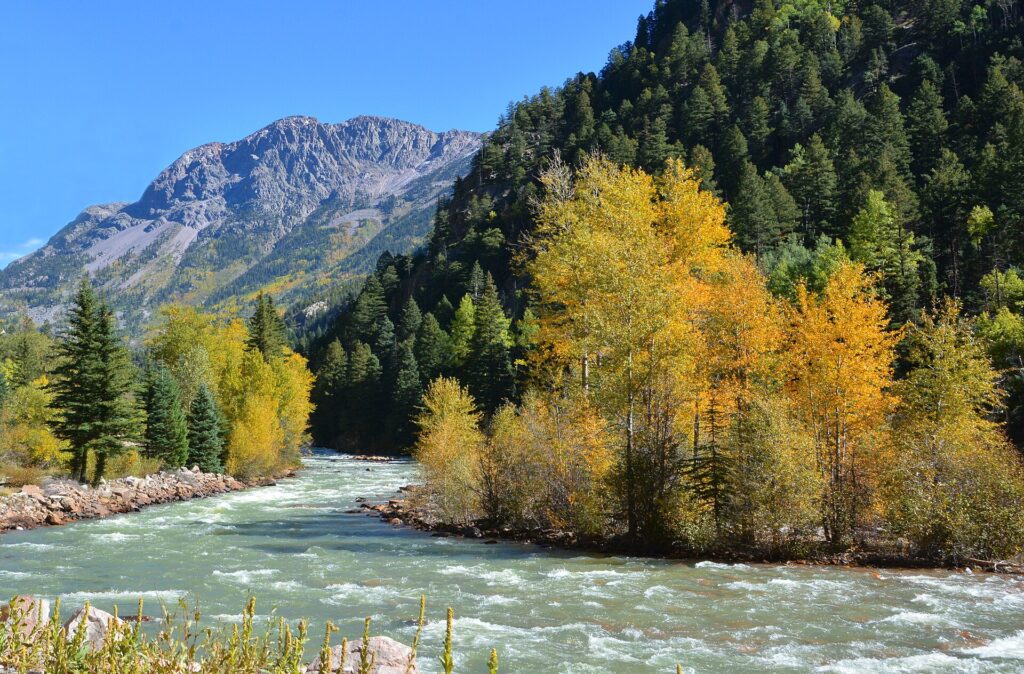
The Gold Medal section right through downtown Durango is one of the most accessible quality fisheries in the state, with public wade water, a real hatch calendar, and fish that test your gear if you let them.
This guide covers the full river, the sections worth knowing, seasonal windows, hatches by month, and the tactics that actually work on this water. If you’re planning a trip, this is everything I wish someone had handed me on my first visit.
Other Rivers In Colorado
- Rio Grande In Colorado
- Arkansas River
- Frying Pan River
- Eagle River
- Taylor River
- Roaring Fork River
- Yampa River
- Cache la Poudre River
- Gunnison River
- Colorado River
- South Platte River
- North Platte River (Colorado)
- Conejos River
- Dolores River
- Big Thompson River
- White River
- San Miguel River
- Elk River
- Crystal River
- Fraser River
- Williams Fork River
Compare Colorado river guides in the Colorado River Directory. If your trip includes another state, use our US fly fishing river guide to compare waters.
The Animas River runs 126 miles from the San Juan Mountains through Durango, Colorado, holding wild rainbow and brown trout, including fish over 20 inches. A 4-mile Gold Medal section through Durango offers public wade access, artificial-only rules, and consistent fishing on midges, caddis, and hoppers from late June through October. Fall (September-October) is the best season.
Why the Animas Earns Its Reputation
The Animas runs through downtown Durango with public wade access, consistent hatches, and wild trout dense enough to justify a dedicated trip.
Gold Medal waters in the heart of Durango
The Colorado Parks and Wildlife Gold Medal designation is not handed out casually. A stretch has to sustain at least 60 pounds of trout per acre and maintain 12 or more fish over 14 inches per acre on a continuous basis.
The Animas holds that status on the 4-mile section from Lightner Creek downstream to Rivera Crossing Bridge, running right through Durango.
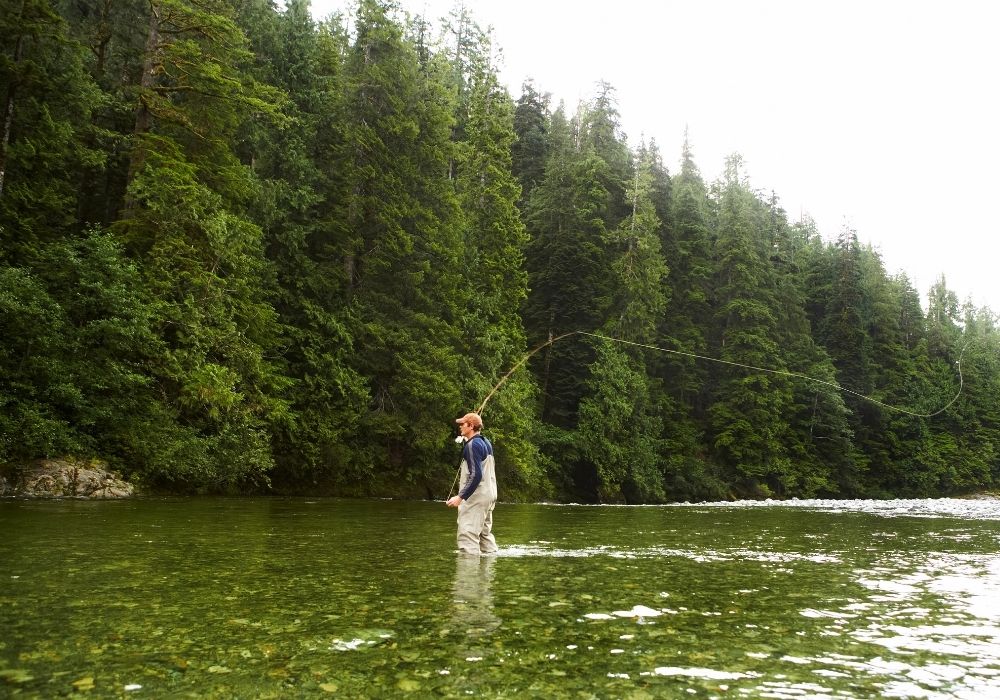
That matters because Gold Medal water produces real fish on public water. You can park on the street, walk to the river, and find yourself in a legitimate trout fishery within minutes. No float plane, no remote access, no private water fee. For a quality freestone river, that kind of walk-in access is rare.
Wild Trout and Trophy Fish
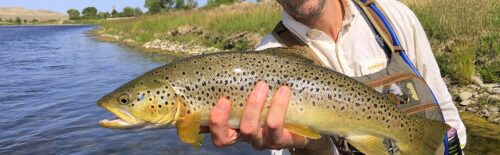
Rainbow trout make up roughly 70 percent of the catch in the Gold Medal reach, with fish running 14 to 18 inches through most of the section. Brown trout run bigger, and the river produces fish over 20 inches regularly, mostly holding near boulders and deep undercut banks.
Further upstream toward Silverton, Colorado cutthroat trout show up in the colder, clearer water. They’re a different fishing experience, spot-and-stalk in open runs rather than the technical tight-line work that dominates the Durango water.
Upper vs. Lower Animas: Choosing Your Section
The Animas fishes differently depending on where you are. Three sections matter: the Gold Medal reach through Durango, the standard-regulation water above it, and the upper river near Silverton.
The Gold Medal reach (Lightner Creek to Rivera Bridge)
This is where most visiting anglers fish, and for good reason. The 4-mile Gold Medal stretch from Lightner Creek to Rivera Crossing Bridge runs artificial flies and lures only, with a two-fish bag limit at 16 inches or longer.
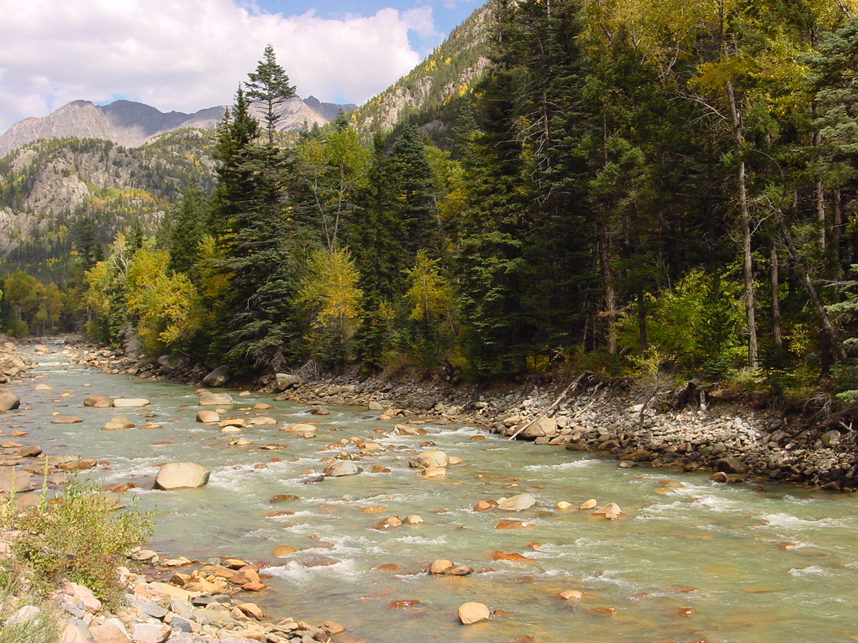
The fish are wild, the hatches are predictable, and a seven-mile corridor of public wade access runs from 32nd Street Bridge all the way to Rivera Bridge.
The river is wide here, around 100 feet across in town, with a mix of fast pocket water, deep runs behind boulders, and slower tailouts. You can fish freestone structure all day without repeating the same water twice.
The standard-regulation water above 32nd Street
From 32nd Street Bridge up to Lightner Creek, you’re in standard-regulation water: four trout per day, bait allowed. The fishing is solid, but I usually stay in the Gold Medal section because the wild fish density is higher and the hatch activity is more consistent.
The upper Animas near Silverton
The upper river is a different fishery. Access is limited due to steep canyon terrain, flows run colder year-round, and you’re fishing for Colorado cutthroat in more remote conditions.
If spot-and-stalk for cutthroat in tight mountain water appeals to you, the upper Animas is worth researching before a trip. It’s best accessed during the post-runoff summer window after the snowmelt settles out.
When to Fish the Animas River
The Animas has four distinct windows worth knowing. Two are excellent, one is dangerous, and one depends on the year.
Spring (March-April): midges and BWOs before the blow-out
March and April are the best spring months. Flows are still manageable, the fish are active after winter, and midge and Blue-Winged Olive hatches fire consistently in the mornings. I’ve had some of the best dry fly hours of any season during a March BWO hatch on a still, overcast afternoon.
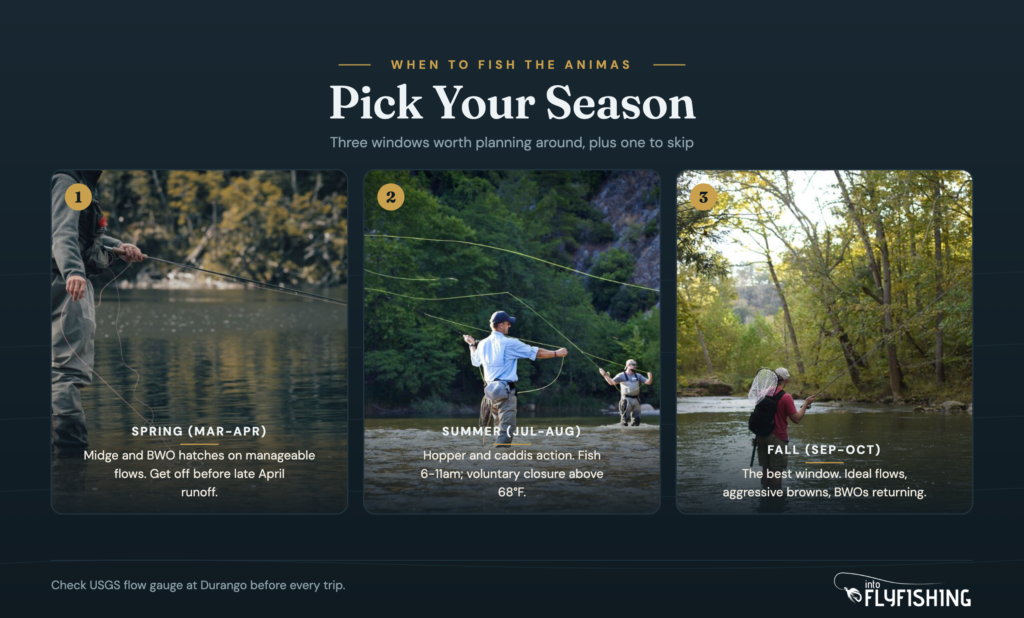
The window closes in late April as snowmelt begins building. Watch the USGS gauge at Durango, and once you see flows climbing past 400 CFS and the water color goes off, plan to stay home.
Runoff (May to early June): stay off it
The Animas is a freestone river with no dam to buffer snowmelt, so spring runoff hits hard and fast. From roughly late April through early June, flows can push well past 800 CFS with heavy silt.
Wading becomes dangerous, the fish move to slow margins, and the fishing is poor. This is the time to drive south to the San Juan River tailwater or save the trip for later in the season.
Summer (July-August): hoppers and caddis, mornings only
Once runoff clears, usually by late June or early July, the Animas switches to a summer fishery. Caddis hatches run morning and evening, hopper fishing picks up along grassy banks, and PMDs appear late morning through early August.
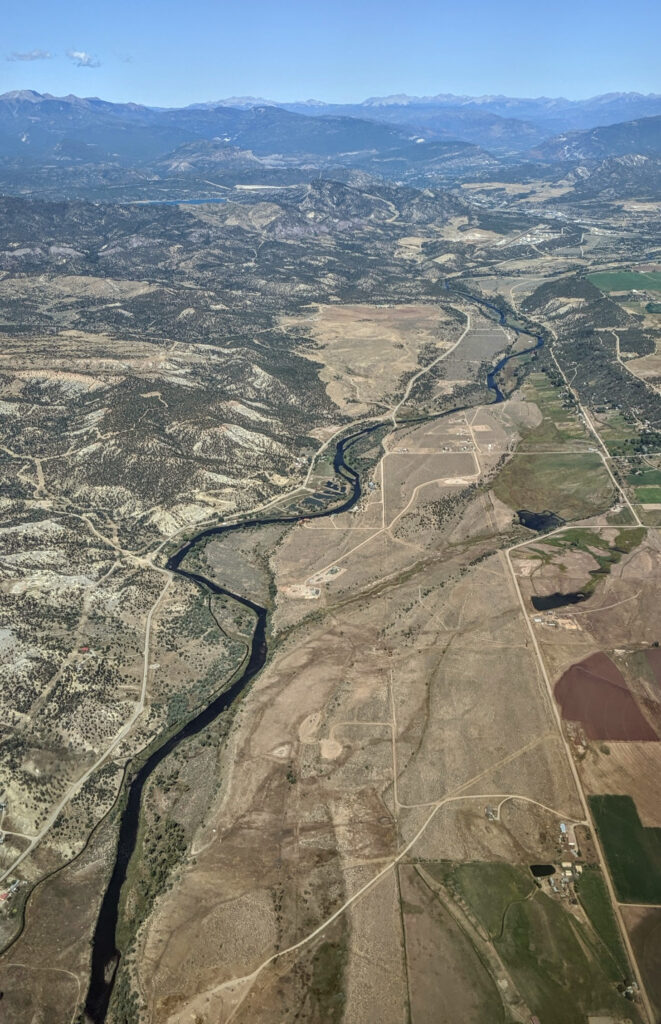
The catch is water temperature. The Animas is a freestone river, and summer afternoon temps can push past 68°F, at which point Colorado Parks and Wildlife issues a voluntary no-fishing request to protect stressed trout.
Fish 6 a.m. to noon on hot days, then call it. If you show up in August, check the USGS temperature data before you gear up.
Fall (September-October): the best window
September and October are the months I point people toward if they only have one trip on the calendar. Water temperatures drop, flows settle into the 200-400 CFS ideal wading range, BWO and midge hatches return, and brown trout begin their pre-spawn aggression phase.
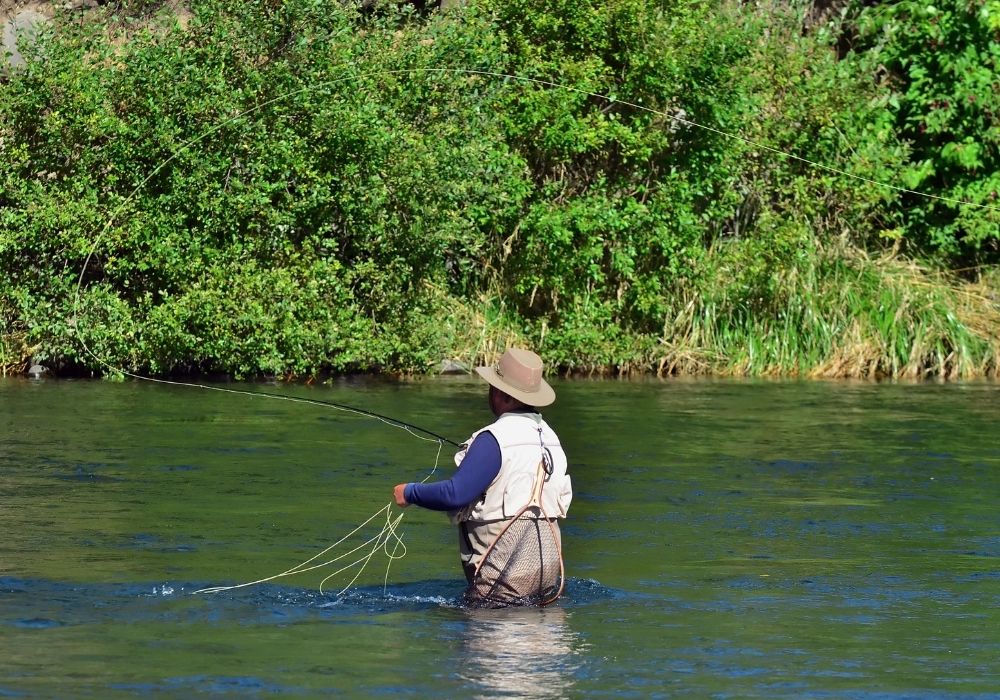
I’ve seen browns that had been ignoring every fly in my box suddenly smashing a streamer in October. The fishing is aggressive and the crowds thin out compared to midsummer.
Winter (November-February): midge nymphing on mild days
Midges hatch on the Animas year-round, and winter days above 40°F can produce good nymphing in the deeper pools. Fish are sluggish and hold in slow water, so dead-drift precision matters more than fly selection. A Zebra Midge or RS2 under an indicator in slow tailouts is the winter playbook here.
Animas River Access Points
The Animas through Durango is a public-access river. Three entry points cover the Gold Medal section from the upper end to the lower boundary near 9th Street.
32nd Street and Memorial Park
The best wade-in access in Durango. Park at Memorial Park off 32nd Street and walk down to the river in under five minutes. The water here has consistent depth changes, plenty of rock structure, and you can work upstream or downstream through quality pocket water. I start most client trips here.
If you want to fish from the bank, the path along the Animas River Trail follows the river for miles and gives you access to slower edges and tailouts without wading.
Oxbow Park boat launch
Oxbow Park has a boat launch that opened in 2020, making it the primary put-in for float trips. Floating the Animas lets you cover the full stretch efficiently and reach water that wading anglers can’t access from the bank. If you’re running a raft or pontoon, coordinate your float distance before you launch so you’re not scrambling for a take-out.
9th Street Park and the fish hatchery
The 9th Street access puts you into the lower end of the public stretch. The fish hatchery area nearby holds consistent fish and gets less pressure than the upper Memorial Park reach. It’s worth the short drive if you find 32nd Street crowded on a weekend morning.
Hatches and Fly Selection
The Animas follows a predictable hatch calendar. Get these five categories right and you’ll have a fly in the water when the fish are looking up.
| Hatch | Season | Sizes | Top Patterns |
|---|---|---|---|
| Midges | Year-round | 20-24 | Zebra Midge, RS2 |
| Blue-Winged Olives | March-April, Sept-Oct | 18-22 | Parachute Adams, RS2 Emerger |
| Caddis | June-September | 14-18 | Elk Hair Caddis, Stimulator |
| PMDs | July-early August | 16-18 | Light Cahill, Pale Morning Dun |
| Hoppers/Terrestrials | July-October | 8-14 | GFA Hopper, Stimulator, Beetle |
| Streamers (trophy browns) | Year-round (peak: fall) | 4-8 | Sculpin, Woolly Bugger |
Midges (year-round, sizes 20-24)
Midges are the backbone of the Animas fishery, hatching every month of the year and forming the bulk of winter and early spring feeding activity. A Zebra Midge or RS2 in sizes 20-22 covers most situations.

Caddis (June-September, sizes 14-18)
Caddis are the dominant summer hatch on the Animas. Spotted Sedges run early in the season, shifting to Green Sedges and other species through August.

An Elk Hair Caddis in size 16 or an Elk Hair with a Hare’s Ear dropper covers both the dry and subsurface phases. Caddis activity peaks in the morning and again in the evening, with a mid-afternoon lull when temps are high.
Blue-Winged Olives (spring and fall, sizes 18-22)
BWOs come on during overcast, lower-light conditions in March-April and again in September-October. The best Animas BWO fishing I’ve had is on gray days with light wind, fish rising in the slower seams below riffles. A Parachute Adams or RS2 emerger in size 18 or 20 is the right call.
Hoppers and terrestrials (July-October, sizes 8-14)
Hopper season on the Animas runs from mid-July through October. Fish the grassy banks, particularly along the Animas River Trail corridor, with a foam-bodied hopper like the GFA or a Stimulator in size 10 or 12.
A Pheasant Tail dropper below the hopper gives you a two-fly setup that covers fish at all levels. The grassy banks above Oxbow Park have the best hopper water in the Gold Medal reach.
Streamers for trophy browns
Big brown trout on the Animas don’t rise to dry flies reliably, especially the fish over 20 inches. A weighted sculpin or dark Woolly Bugger fished slow and deep near boulders and undercut banks is the targeted approach.

Swing or dead-drift, pause the fly at the end of the swing, and hold on. Fall is the best streamer season, but I’ve hit big browns on streamers in any month with off-color water.
- Zebra Midge, sizes 20-22 (black/silver)
- RS2 Emerger, sizes 20-22
- Elk Hair Caddis, sizes 14-16
- Hare’s Ear Nymph, sizes 14-16
- Pheasant Tail Nymph, sizes 16-18
- Parachute Adams, sizes 16-18
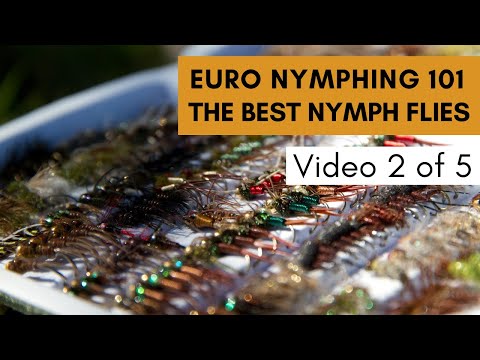
- Pat’s Rubberlegs, size 8-10 (brown or black)
- Pale Morning Dun, sizes 16-18
- GFA Hopper, sizes 10-12
- Stimulator, sizes 10-12
- Woolly Bugger, sizes 6-8 (olive or black)
- Sculpin pattern, sizes 4-6
Tactics That Work on Animas Water
Three setups account for most fish on the Animas across all seasons: a dry-dropper in the riffles, tight-line nymphing in deep pockets, and streamers swung near boulder structure.
The Animas is big-pocket freestone water. Learning to read the structure here pays off faster than any single fly pattern will.
Dry-dropper setups in riffles and runs
The standard Animas rig for guides and visiting anglers alike is a buoyant dry fly with a nymph dropper 12 to 18 inches below it.
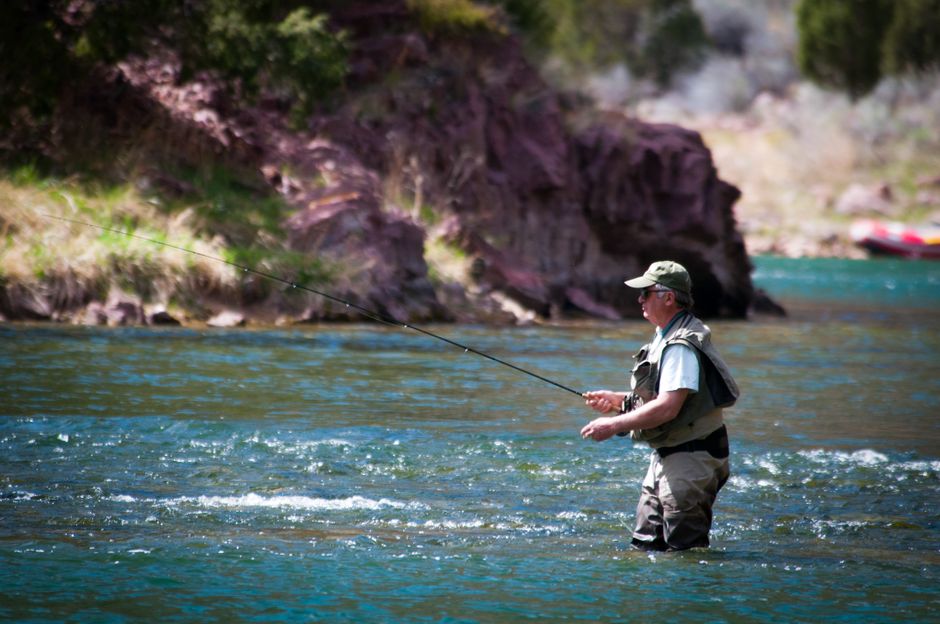
The dry acts as an indicator and catches rising fish; the nymph covers fish holding on the bottom. A Stimulator or Elk Hair Caddis on top with a Pheasant Tail or Hare’s Ear below covers both phases of most hatches.
Fish the seams at the edge of fast water and the tailouts below riffles. Those are where Animas trout stack up during feeding periods. If you’re making mistakes on your first season, our roundup of common beginner errors is worth reading before you hit the water.
Euro nymphing in deep pockets
The deep boulder pockets in the Gold Medal reach hold fish all season, and they’re hard to cover with a standard indicator rig. Euro nymphing with weighted flies like Pat’s Rubberlegs or a heavy Perdigon reaches the bottom faster and gives you direct contact with the drift.
I run two-fly Euro setups on most guide days from August through November, covering more water and getting deeper than any indicator setup allows.
Streamer fishing near boulders
Target the upstream face and downstream edges of the large mid-river boulders for trophy browns. Cast upstream, let the fly sink to the bottom, then swing it across the current seam.
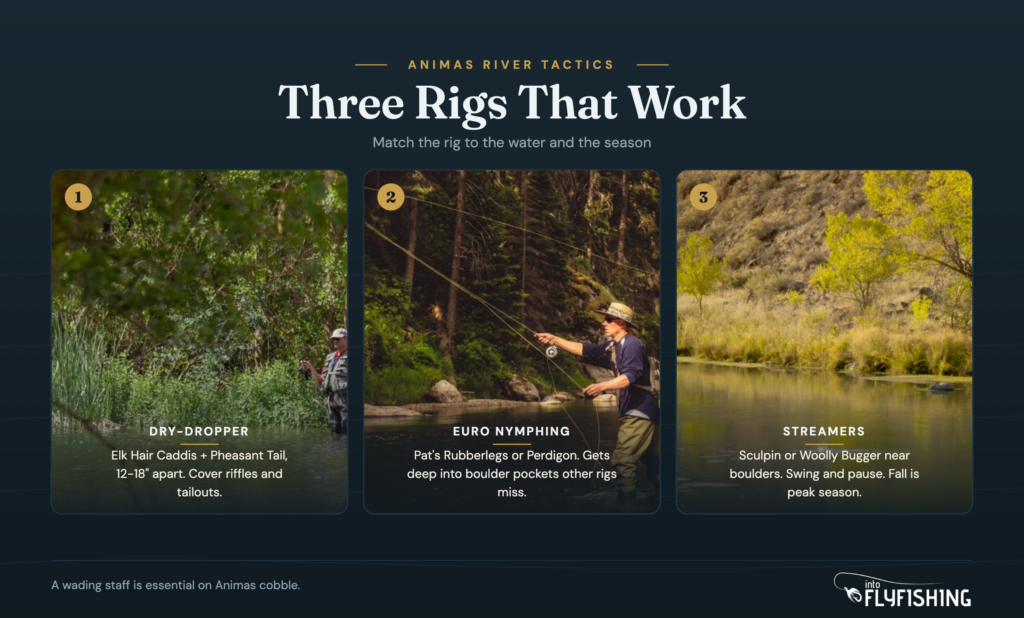
Hold the fly stationary at the end of the swing before stripping back. Most strikes come at the swing. Use a 6-weight rod with a sink-tip line and 3X fluorocarbon, and expect violent takes.
Gear for the Animas River
Three categories matter on the Animas: rod weight for the conditions, tippet setup by technique, and wading gear that handles slick cobble bottom.
Rods and line weights
A 9-foot 5-weight is the right all-around rod for the Animas. It handles dry flies and nymphs in moderate currents, casts well into the wind for hopper season, and has enough backbone for the large browns that show up in fall.
If you’re focused on streamers or fishing big water in high flows, a 9-foot 6-weight with a sink-tip line gives you more authority on the swing.
Choosing the right rod for Colorado trout water is a bigger decision than most anglers expect. Our team’s guide to the best fly rods for trout covers the specific models that perform on western freestone rivers like the Animas, with hands-on testing notes from the team.
Leaders and tippet for each approach
A 9-foot tapered leader down to 4X is the starting point for dries and nymphs. Drop to 5X for midge fishing in clear low water.
Go up to 3X fluorocarbon for streamers, where abrasion resistance matters near the rocky bottom structure. Our leaders and tippet guide explains the full system if you’re figuring out sizes and materials for the first time.
Wading gear on slick freestone
The Animas bottom is slick cobble and algae-covered rock. A wading staff is not optional here. I carry one on every trip, and the clients who skip it usually find out why within the first hour.
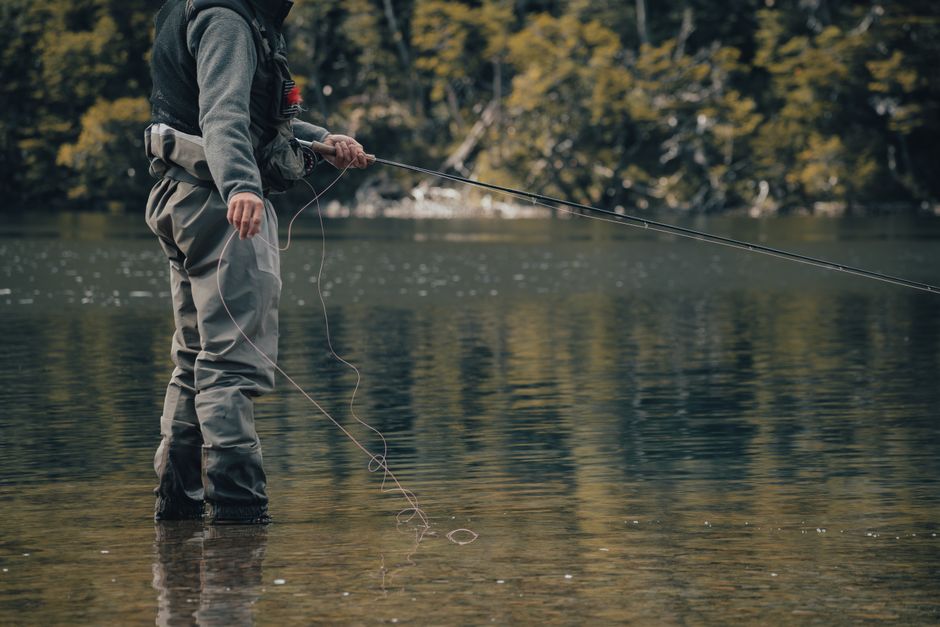
Rubber-soled boots with metal studs or felt soles work well; plain rubber on this river will put you in the water. Our guide to the best wading boots has the specific models I’d recommend for freestone bottom like the Animas.
A budget perspective: the full gear setup for a day on the Animas ranges from entry-level to high-end. If you’re sorting out what your first setup should cost, our breakdown of fly fishing startup costs puts the numbers in context.
Regulations and Licensing
The Animas runs two regulatory zones, and getting this wrong costs you a citation.
The Gold Medal section from Lightner Creek to Rivera Crossing Bridge is artificial flies and lures only, with a two-fish bag limit at 16 inches or longer minimum. No bait, no treble hooks, no exceptions.
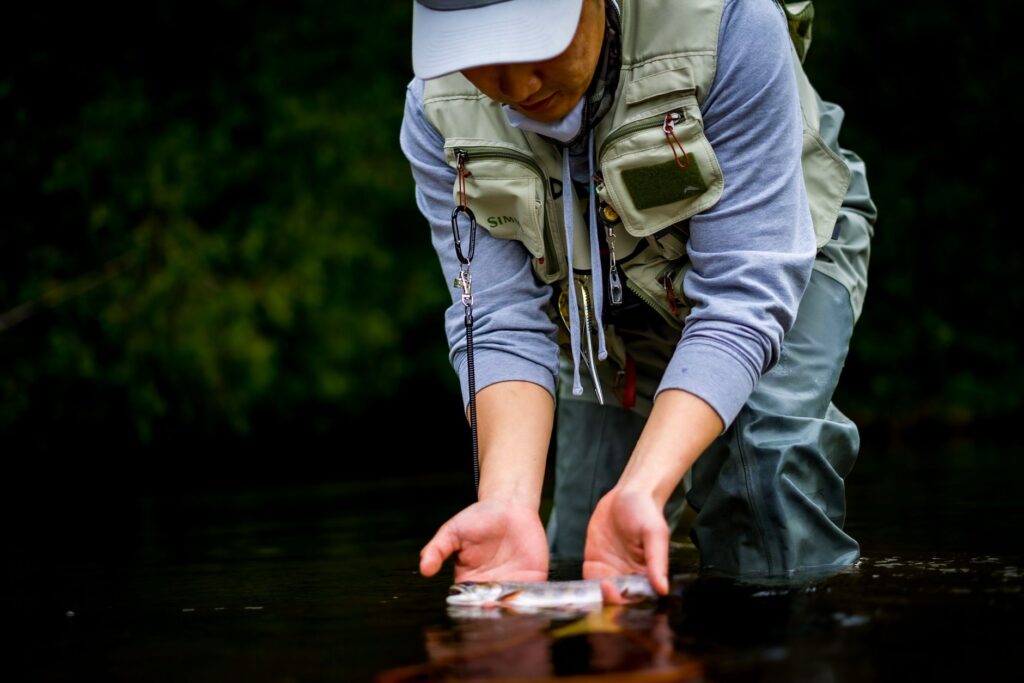
The standard water from 32nd Street Bridge down to Lightner Creek operates under standard Colorado regulations: four trout per day, bait permitted. The standard regs also apply to the upper river above 32nd Street.
A valid Colorado fishing license is required anywhere on the river. Licenses are available online through Colorado Parks and Wildlife. If you’re also planning to fish the San Juan River tailwater in New Mexico, you’ll need a separate New Mexico license.
Our full breakdown of how to get a fishing license in every state has the direct links and current pricing for Colorado.
Is the Animas River Still Polluted?
This is the question I get asked more than any other about the Animas, so I’ll answer it directly: the Gold Medal section through Durango fishes well and the trout are healthy.
In August 2015, an EPA crew accidentally breached a plug at the Gold King Mine north of Silverton, releasing approximately 3 million gallons of contaminated mine wastewater into Cement Creek, a tributary of the Animas. The river turned bright orange-yellow for several days and was temporarily closed. After sediment testing confirmed no long-term threat to human health, the river reopened.
Studies since the spill showed little to no lasting impact on the Durango section, where water quality had already been better than in the upper reaches prior to 2015.
The upper Animas near Silverton was more affected, but that’s tied to decades of cumulative mining drainage that predates the Gold King incident. The Durango fish population recovered quickly, and the Gold Medal reach produces the same density of wild fish it did before the spill.
The upstream situation near Silverton is more complicated, with ongoing remediation work. But for the fishing that most visiting anglers care about, the Durango section is productive, the water tests clean, and Trout Unlimited’s Five Rivers chapter has been active in the continued recovery work.
FAQ: Fly Fishing the Animas River
Rainbow trout are the most common catch in the Gold Medal reach, with fish averaging 14-18 inches. Brown trout hold the deep boulder structure and regularly exceed 20 inches. Colorado cutthroat trout live in the upper river near Silverton.
The Gold Medal section through Durango fishes well today. The 2015 Gold King Mine spill caused a short-term closure but studies showed little to no long-term impact on the Durango fishery. The upper river near Silverton remains more affected by historical mining impacts.
September and October are the best months: ideal flows of 200-400 CFS, clear water, aggressive brown trout, and returning BWO and midge hatches. March and April are the best spring window before runoff. Avoid May through early June.
A Zebra Midge (20-22), RS2 (20-22), Elk Hair Caddis (14-16), Pheasant Tail (16-18), Hare’s Ear (14-16), Parachute Adams (16-18), GFA Hopper (10-12), Stimulator (10-12), and a Woolly Bugger (6-8) covers all seasons on the Animas.
Yes. A valid Colorado fishing license is required anywhere on the river. The Gold Medal section (Lightner Creek to Rivera Crossing Bridge) also requires artificial flies and lures only, with a 2-fish bag limit at 16 inches minimum.
Amazon and the Amazon logo are trademarks of Amazon.com, Inc, or its affiliates.
As a part of the Amazon Associates Program and other affiliate programs, Into Fly Fishing® may receive a comission if you order products through links on this website.