As an Amazon Associate I earn from qualifying purchases.
I’ve held fishing licenses in more states than I can count on one hand, and the process is almost identical every time. You find the right agency, pick a license type, pay, and you’re legal in minutes. The two points that trip up first-timers are which license type to buy and whether fly fishing requires a separate permit. Both have short answers.
If you’re new to fly fishing, it helps to know the basics before you sort out licensing. The fly fishing glossary covers the terminology you’ll run into when you’re reading license descriptions or talking to fly shop staff for the first time.
This guide covers how to buy a fishing license in any state, what types exist, what things cost in general ranges, who’s exempt, and a state-by-state breakdown so you can find what you need without digging through state agency sites.
Quick answer: Buy a fishing license through your state’s fish and wildlife agency website, at any major sporting goods store, or over the phone. Most states issue it instantly and it’s valid the same day. Resident annual licenses run $10-40 in most states; non-resident annual licenses typically run $30-80.
Do You Need a Fishing License for Fly Fishing?
Yes, you need a fishing license. Every US state requires one for freshwater fishing regardless of method. There’s no such thing as a separate fly fishing license anywhere in the country. A standard fishing license covers spinning, bait, and fly fishing alike. The method you use doesn’t change the requirement.

This surprises some people who assume fly fishing is treated differently because it’s associated with catch-and-release or conservation-focused anglers. It isn’t. From a licensing standpoint, a fly rod is the same as a spinning rod. The license covers the act of fishing, not the gear you’re using to do it.
Saltwater fishing is a different situation. Some states require a separate saltwater license or endorsement on top of a freshwater license. A few states fold both into a single standard license. A handful of states have free saltwater registration programs that still require you to sign up before you go. Before you wade a tidal flat or cast in the surf, check whether your state needs an additional saltwater stamp or registration. The rules aren’t uniform, and the fine for missing a required saltwater endorsement is the same as fishing without any license at all.
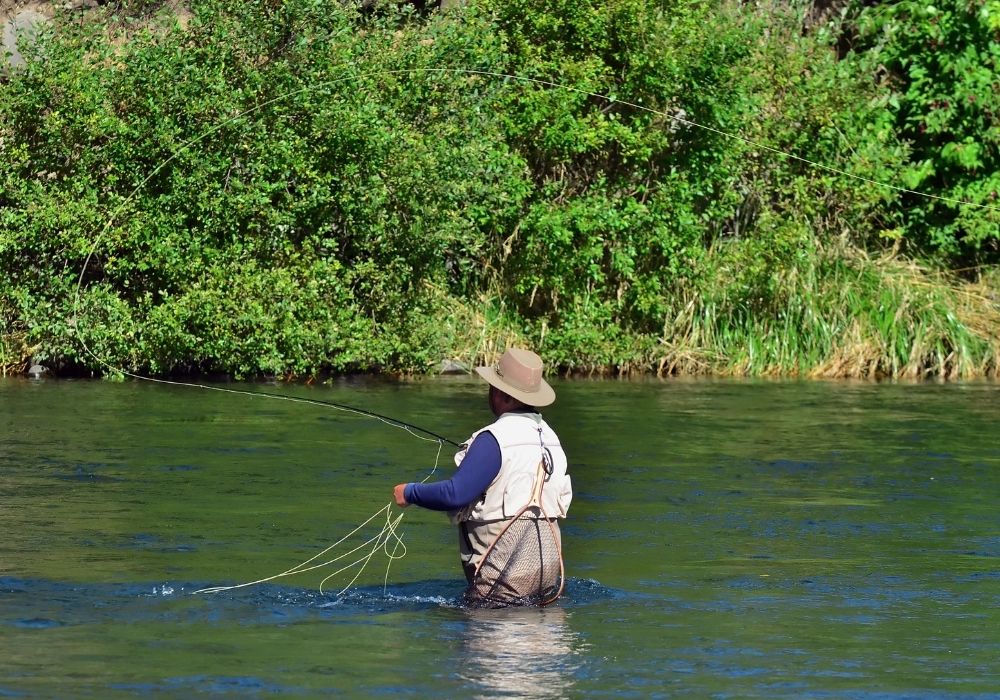
A few other edge cases apply. Catch-and-release still requires a license in every state. Fishing in a private stocked pond on someone else’s property typically requires a license unless the pond is entirely on private land and entirely closed to outside access. And fishing in national parks requires a state license, not a separate federal permit, except for a few specific waters where special regulations apply.
The bottom line: if you’re wetting a line anywhere in the US, assume you need a license and verify the specific requirements for the state and water type before you go.
How to Get a Fishing License: 3 Ways That Work in Every State
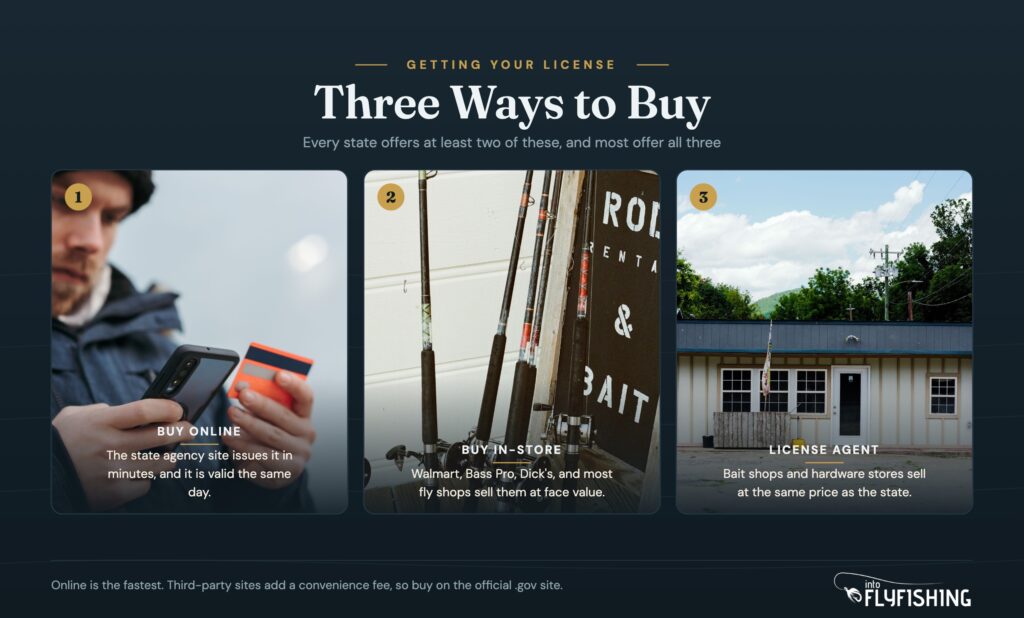
Every state offers at least two of these three purchase methods, and most offer all three. Online is the fastest by a wide margin, but the others work fine if you prefer them or need them.
Buy Online Through Your State’s Fish and Wildlife Agency
This is the method I use every time. Go directly to your state’s fish and wildlife or natural resources agency website and buy there. The license shows up in your email or in your account immediately. You can print it or pull it up on your phone. It’s valid the same day in every state, no waiting period.
One thing to avoid: third-party license sites pop up at the top of search results and charge a convenience fee on top of the license cost. That fee goes to the third-party site, not to your state’s fish and wildlife fund. Always buy from the official state agency website. If you’re not sure which site is official, search your state name plus “fishing license” and look for the .gov domain in the URL.
Most state agency sites let you store your license in an account, which means you can pull up digital proof on your phone if a warden checks you on the water. A few states also have dedicated fishing apps that store your license and let you report catches. Worth checking if your state offers one.
The online method also makes buying non-resident licenses simple. You don’t need to be physically in the state to buy the license before you arrive. Buy it from home, save the PDF, and you’re covered from the moment you step on the water.
Buy In-Store at a Sporting Goods Retailer
Walmart sells fishing licenses at the sporting goods counter at face value, with no markup and no convenience fee. So do Bass Pro Shops, Cabela’s, Dick’s Sporting Goods, and most independent fly shops. The in-store option is good when you want to ask questions about local regulations or pick up gear at the same time.
Fly shops in particular are worth a stop when you’re fishing new water. The staff know current conditions, what flies are working, and will often point you to the best access points. Walking in for a license and leaving with a hot tip on where the browns are stacked is not an unusual outcome.
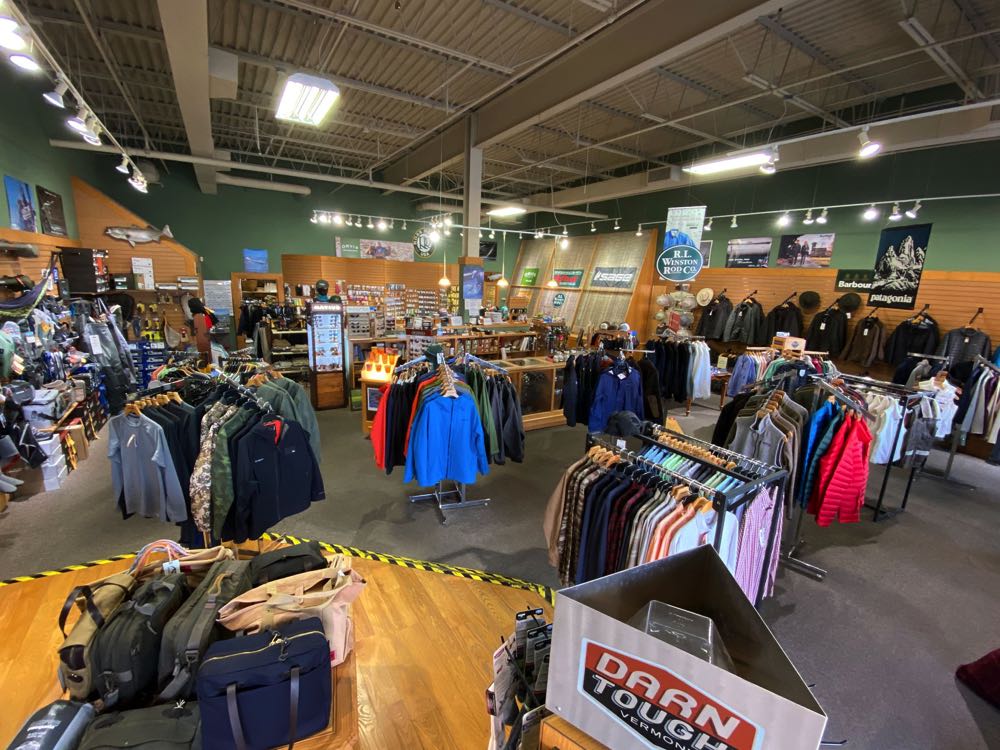
In-store licenses print on the spot. You walk out with a paper license you can fold in your wallet. Some shops also carry regulation booklets for free, which saves you from having to find the current regs online later.
Hours matter here. Fly shops are typically open 7 a.m. to 6 p.m., and Walmart sporting goods counters have their own hours that aren’t always the same as the store’s. If you’re planning an early morning start and need an in-store license, buy it the evening before.
Buy by Phone or In Person at a License Agent
Most states maintain a network of license agents: local hardware stores, bait shops, tackle dealers, and sometimes gas stations in rural areas near fishing destinations. You can also call your state agency directly and purchase over the phone in some states. This method is built for anglers without reliable internet access and produces a paper license you can carry immediately.
License agents sell at the same price as the state agency. They don’t have authority to charge more. If an agent quotes you a price above the posted rate, it’s worth checking the state agency website before you pay.
In-person purchases at a state agency office are also possible in most states, though most agency offices aren’t conveniently located near fishing access. This option matters more for people handling complex licensing situations, like multi-year licenses or combination stamps, where it helps to talk to someone directly.
Types of Fishing Licenses
License types look different state by state, but the categories are consistent everywhere. Knowing which one applies to you before you hit the checkout screen saves time and prevents buying the wrong thing.
Resident vs. Non-Resident Licenses
Residency is the biggest factor in what you pay. A resident license applies if the state is your primary legal residence. A non-resident license applies to everyone else visiting from out of state. Non-resident licenses cost more in every state, sometimes significantly more. A resident annual license that runs $25 might be $65 as a non-resident in the same state.
Proving residency usually means a valid in-state driver’s license or state ID. Some states also accept utility bills, vehicle registration, or voter registration. If you’ve recently moved to a state and your ID hasn’t been updated yet, check the agency’s residency rules before buying a resident license. Using the wrong one is treated the same as fishing without one.
If you fish a neighboring state a few times a year, run the numbers on non-resident annual versus short-term licenses. Fish two or three days in a season and the annual often breaks even or comes out ahead, especially if the state has an attractive fishery you return to regularly.
Some states offer reduced-price non-resident licenses for people who own property in the state. It’s not universal, but worth checking if you have a vacation property or family land across a state line.
Annual, Multi-Year, and Short-Term Licenses
Annual licenses cover a full season, typically running either on the calendar year or as a 12-month period from the purchase date, depending on the state. Calendar-year licenses expire December 31 regardless of when you bought them. A 12-month license bought in October gives you through the following October. Check which format your state uses before buying late in the year.
Multi-year licenses, typically 2-year, 5-year, and lifetime options, are available in many states at a discount over buying annual licenses repeatedly. A lifetime license can be a good value for young anglers. The math changes by state, but in general a lifetime license pays off within 10 to 15 years of buying it.
Short-term licenses cover 1-day, 3-day, or 7-day windows. They’re built for visitors who fish once or twice a trip. If you’re a resident or you fish more than two or three days in a season, the annual is almost always cheaper. Do the math: a $10 one-day license bought four times a year costs $40, which often exceeds an annual license in the same state.
Some states also offer “combination” short-term licenses that cover both fishing and a specific activity like trout stamp or lake access. Read the description carefully before buying to make sure you’re getting coverage for the water you plan to fish.
Combination Hunting and Fishing Licenses
Many states offer a bundle that covers both hunting and fishing under one license or at a discounted combined price. If you hunt, it’s worth checking the combination license cost before buying the two separately. The savings vary by state but are often $10 to $20 per year over buying individual licenses.
Combination licenses are typically only available to residents. Non-residents usually have to buy hunting and fishing licenses separately. The bundle doesn’t always include all the endorsements you need, so check whether a trout stamp, salmon stamp, or saltwater endorsement is included or has to be added separately.
How Much Does a Fishing License Cost?
Resident annual freshwater licenses generally run $10 to $40 across most states. Non-resident annual licenses typically land in the $30 to $80 range. One-day licenses sit in the $5 to $15 range depending on the state and your residency status. These are ranges, not guarantees; states set their own fees and update them on their own schedules.
Additional stamps and endorsements add to the base cost. A trout stamp, required in some states for fishing designated trout waters, typically runs $5 to $15. A salmon stamp, a Great Lakes fishing license, or a saltwater endorsement each add separately. You can quickly get to $60 or $70 in a state that layers multiple required endorsements on top of the base license.
Always check the current rate on your state’s official agency website before you budget. The number you find in an old forum post or a friend’s memory may not match what the agency charges today. Most states review and adjust their license fees every few years, and the increases are usually not announced loudly.
License cost is usually the smallest line item once you’ve bought gear. If you want the full picture of what getting into fly fishing actually runs, the how much fly fishing costs to start breakdown covers everything from rods to waders to licenses in one place, with honest numbers on what you can skip and what you actually need.
Fishing license fees fund state fish and wildlife programs directly, including stocking programs, habitat restoration, stream access projects, and fish surveys. The Federal Aid in Sport Fish Restoration Act also uses license sales as a multiplier to draw down federal matching funds. The more licenses sold in a state, the more federal money that state’s fish and wildlife program can access. Buying a license when you fish is a direct contribution to the resource.
Fishing License Exemptions: Who Doesn’t Need One?
Every state has exemptions, though the specifics vary. Here are the common ones and the conditions that travel with each of them.
Youth under 16. Most states don’t require a fishing license for anglers under 16. A few states set the threshold at 15 or 17, and some require a free youth license registration even if there’s no fee attached. Check your state’s specific cutoff before assuming your kid is covered. The exemption typically applies at the moment you’re fishing, not your age at the start of the license year.
Seniors. Some states offer free or reduced-price licenses for anglers above a certain age, typically 65 or 70. Not all states participate, and the discount rules vary. A few states require a senior to buy a standard license at full price. Some offer reduced-price senior licenses only to residents, not to out-of-state visitors who happen to be seniors. Look this up specifically rather than assuming.
Free fishing days. Every state designates one or two weekends per year when anyone can fish without a license. These are typically scheduled in late spring or early summer and are designed to introduce new anglers to the sport. The same regulations that apply on licensed days still apply on free fishing days: size limits, bag limits, and gear restrictions don’t change. Search your state’s fish and wildlife site for the current year’s free fishing weekend dates.
Military and veterans. Many states offer discounts or free licenses to active duty military personnel and veterans. The terms differ considerably: some require proof of service at time of purchase, some apply only to residents, some cover both residents and non-residents currently on active duty orders in the state. A few states offer completely free annual licenses to veterans with a service-connected disability rating above a certain threshold.
Disabled anglers. Most states have a reduced-fee or free license option for anglers with qualifying disabilities. The documentation requirements vary, but a physician’s statement or a state-issued disability certification typically qualifies. Contact your state fish and wildlife agency directly if this applies to you, since the exemption details aren’t always prominently listed on the standard license purchase page.
Private land fishing. A limited number of states allow landowners to fish private ponds and lakes on their own property without a license. This exemption usually applies only to the landowner and immediate family members and does not extend to guests or hired guides. In most states, even fishing a pond you own requires a license if that pond receives any state stocking or if the property is accessible to the public in any way.
Fishing License Requirements by State
Every state has its own agency, its own fee schedule, and its own rules about what licenses are required for which waters. The table below covers the key details for all 50 states: the agency name, resident annual license cost, non-resident annual license cost, and the youth exemption age threshold.
Use it as a starting point. License fees change periodically and regulations are updated each year, so confirm current fees and rules on your state’s official fish and wildlife website before you head out. The agency name in the table will help you find the right site quickly.
| State | Agency Name | Get Your License |
|---|---|---|
| Alabama | Outdoor Alabama | Buy Online |
| Alaska | AK Fish & Game | Buy Online |
| Arizona | AZ Game & Fish | Buy Online |
| Arkansas | AR Game & Fish | Buy Online |
| California | CA Dept of Fish & Wildlife | Buy Online |
| Colorado | CO Parks & Wildlife | Buy Online |
| Connecticut | CT DEEP | Buy Online |
| Delaware | DE Fish & Wildlife | Buy Online |
| Florida | FL Fish & Wildlife | Buy Online |
| Georgia | GA Outdoor Recreation | Buy Online |
| Hawaii | HI Div of Aquatic Resources | Buy Online |
| Idaho | ID Fish & Game | Buy Online |
| Illinois | IL DNR | Buy Online |
| Indiana | IN DNR | Buy Online |
| Iowa | Iowa DNR | Buy Online |
| Kansas | KS Wildlife & Parks | Buy Online |
| Kentucky | KY Fish & Wildlife | Buy Online |
| Louisiana | LA Wildlife & Fisheries | Buy Online |
| Maine | ME Inland Fisheries & Wildlife | Buy Online |
| Maryland | MD DNR | Buy Online |
| Massachusetts | MA Div of Fisheries & Wildlife | Buy Online |
| Michigan | MI DNR | Buy Online |
| Minnesota | MN DNR | Buy Online |
| Mississippi | MS Dept of Wildlife & Fisheries | Buy Online |
| Missouri | MO Dept of Conservation | Buy Online |
| Montana | MT Fish, Wildlife & Parks | Buy Online |
| Nebraska | Nebraska Game & Parks | Buy Online |
| Nevada | NV Dept of Wildlife | Buy Online |
| New Hampshire | NH Fish & Game | Buy Online |
| New Jersey | NJ Fish & Wildlife | Buy Online |
| New Mexico | NM Dept of Game & Fish | Buy Online |
| New York | NY DEC | Buy Online |
| North Carolina | NC Wildlife Resources | Buy Online |
| North Dakota | ND Game & Fish | Buy Online |
| Ohio | Ohio DNR | Buy Online |
| Oklahoma | OK Dept of Wildlife | Buy Online |
| Oregon | OR Dept of Fish & Wildlife | Buy Online |
| Pennsylvania | PA Fish & Boat Commission | Buy Online |
| Rhode Island | RI Div of Fish & Wildlife | Buy Online |
| South Carolina | SC DNR | Buy Online |
| South Dakota | SD Game, Fish & Parks | Buy Online |
| Tennessee | TN Wildlife Resources Agency | Buy Online |
| Texas | TX Parks & Wildlife | Buy Online |
| Utah | UT Div of Wildlife Resources | Buy Online |
| Vermont | VT Fish & Wildlife | Buy Online |
| Virginia | VA Dept of Wildlife Resources | Buy Online |
| Washington | WA Dept of Fish & Wildlife | Buy Online |
| West Virginia | WV DNR | Buy Online |
| Wisconsin | WI DNR | Buy Online |
| Wyoming | WY Game & Fish | Buy Online |
Get Your Fly Fishing Gear Together
Once you’ve got the license sorted, the next step is getting on the water with the right gear. We’ve tested a lot of it across a lot of different water types, and the pieces that matter most for a beginner are the rod, the boots, and the terminal tackle. Get those three right and the rest fills in naturally as you fish more.
The rod is where beginners start, and where beginners overthink it. There are dozens of options at every price point, and the marketing tends to obscure what actually matters for a beginner. Our guide to the best beginner fly rods covers the options we’ve put through their paces across multiple price points, with honest assessments of what performs and what’s overpriced for the level of fishing you’ll be doing when you’re starting out.
Footing matters more than new anglers expect. Slick river rock and uneven gravel are unforgiving, especially in current. Good wading boots with the right sole for the water type you’re fishing keep you stable and protect you when the footing gets dicey. Don’t skip this one thinking any boot will do. Ankle rolls in a fast run are how wading trips end early.
Once the rod and boots are handled, the terminal tackle side is where a lot of beginners stall out. The knots, the leader, the tippet, and how it all connects tends to get complicated-looking fast. Understanding leaders and tippet is the first piece, and knowing the knots you’ll actually use is the second. Those two things together cover the rigging questions you’ll face on the water for the first several months.

Frequently Asked Questions
Yes. Every US state requires a standard fishing license for fly fishing. There’s no separate fly fishing license anywhere in the country. The standard license covers all legal fishing methods, including fly fishing, spin fishing, and bait fishing. The license covers the act of fishing, not the gear or method.
Yes. Walmart sells fishing licenses at the sporting goods counter at face value with no added fees. Bass Pro Shops, Cabela’s, Dick’s Sporting Goods, and most local fly shops sell them as well. The license is valid the same day you buy it.
Buying online through your state’s official fish and wildlife agency takes about five minutes. The license is issued immediately and is valid the same day. In-store purchases are also same-day. There’s no waiting period for a fishing license in any US state.
Resident annual licenses generally run $10 to $40. Non-resident annual licenses typically run $30 to $80. Short-term one-day licenses are usually $5 to $15. Every state sets its own fees and updates them periodically, so check the current rate on your state’s official agency website before you buy.
In most cases, no. Every state requires a fishing license for adults fishing public waters. Exceptions include youth under 16 in most states, free fishing days every state has once or twice a year, certain senior and disability exemptions, and in limited cases landowners fishing private waters they own. Fines for fishing without a license typically run $100-500 for a first offense.
Amazon and the Amazon logo are trademarks of Amazon.com, Inc, or its affiliates.
As a part of the Amazon Associates Program and other affiliate programs, Into Fly Fishing® may receive a comission if you order products through links on this website.