As an Amazon Associate I earn from qualifying purchases.
I printed my first fly fishing knot guide off the internet in 2009 and laminated it. It lived in my vest for three seasons before the corners fell apart. It wasn’t pretty, but it kept me from tying a blood knot where a surgeon’s goes and a clinch where a Davy would’ve been smarter.
This is that guide, rebuilt. Five connections, one knot each, laid out in rig order so you can work from the reel to the fly and never second-guess the next move.
Print this page. Laminate it if you’re serious. Or just bookmark it and stop Googling knots at the truck.
The 5 Connections in Every Fly Rig
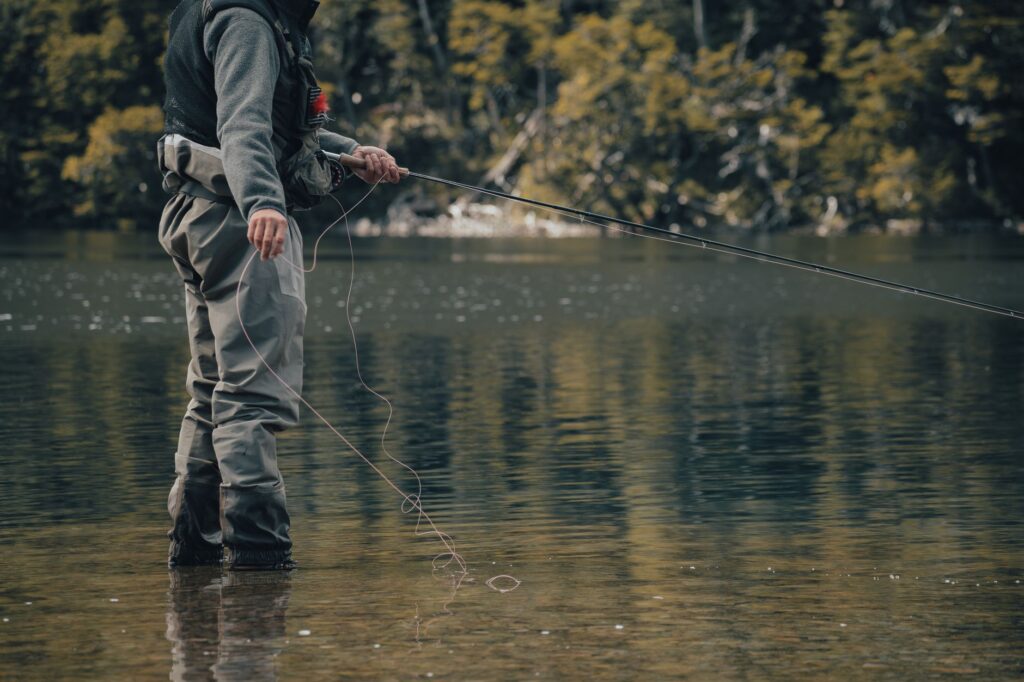
Every fly rig is the same chain regardless of what you’re fishing: reel to backing, backing to fly line, fly line to leader, leader to tippet, and tippet to fly. Five junctions. That’s it.
You need one reliable knot per junction. Learn those five and you can build a complete rig anywhere, in any weather, for any fish. Everything else on this cheat sheet is a backup or an upgrade for specific jobs.
The first two connections get tied once a season at most. The last two you’ll tie on the water, sometimes with cold fingers, so practice those until they’re automatic. A full breakdown of all 12 fly fishing knots is in our complete fly fishing knots guide if you want the longer read.
| Connection | Knot | Difficulty | When to Retie |
|---|---|---|---|
| Reel to backing | Arbor knot | Easy | Once a season |
| Backing to fly line | Albright knot | Moderate | Once a season |
| Fly line to leader | Loop-to-loop | Easy | When leader changes |
| Leader to tippet | Double surgeon’s | Easy | Every session / as needed |
| Tippet to fly | Improved clinch or Davy | Easy | Every fly change |
The Printable Fly Fishing Knots Cheat Sheet
The graphic below covers every connection point in a fly rig. Print it, fold it, put it in your vest. Or keep this tab open on your phone at the truck before you walk to the water.
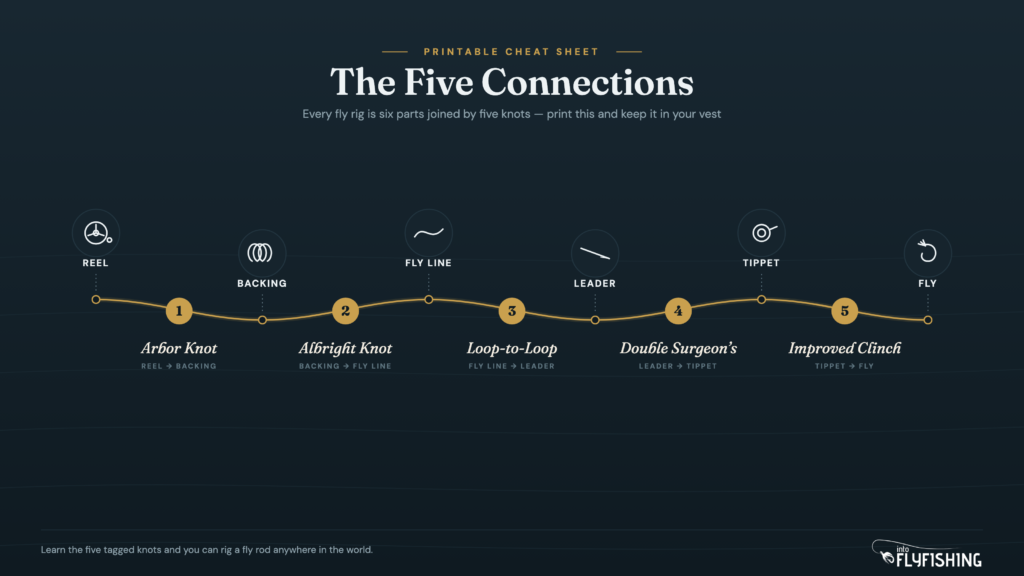
The five connection points in rig order are: arbor knot, Albright knot, loop-to-loop, double surgeon’s knot, and improved clinch or Davy knot. Every knot earns its place at one specific junction and doesn’t belong at the others.
Connection by Connection: Which Knot and Why
Here’s the full breakdown, in rig order from reel to fly.
Reel to Backing: The Arbor Knot
The arbor knot is the right call here and you’ll tie it about once a year. It doesn’t need to be the world’s strongest knot because you will never land a fish on your backing knot alone. It needs to stay put on the arbor and not slip.
Wrap the backing around the spool arbor. Bring the tag end back alongside the standing line and tie a loose overhand knot around the standing line. Tie a second overhand knot in the tag itself, about an inch below the first. Pull the standing line and the first knot slides down against the arbor; the second knot jams against the first. Trim the tag.
Two knots, thirty seconds. Done for the season.
Backing to Fly Line: The Albright Knot
The Albright joins two lines of very different diameters, which is exactly the problem here. Backing is thin; fly line is thick. The Albright slides through the guides on a long run without catching, which matters the one time a fish takes you into the backing.
Double the end of the fly line into a loop about two inches long. Thread ten inches of backing through that loop. Pinch the backing against both legs of the doubled fly line and wrap it back over itself and both legs, ten to twelve tight turns, working toward the loop’s closed end. Push the backing’s tag back out through the loop on the same side it entered. Wet it, slide the wraps toward the loop end, seat it hard, and trim.
Fly Line to Leader: Loop-to-Loop (or Nail Knot)
Most modern fly lines ship with a welded loop on the front end, and most tapered leaders come with a loop too. That makes this connection a ten-second job: pass the fly line’s loop through the leader’s loop, then pass the entire leader through the fly line’s loop. Pull the two loops together so they link like two chain links.
Get this wrong and you form a girth hitch instead, which pinches the connection and weakens it noticeably. The test is the shape: chain links mean you did it right. Anything that looks choked or crossed means back up and try again.
If your fly line doesn’t have a welded loop, tie a nail knot or build a perfection loop in the leader butt. Our perfection loop tutorial covers that step by step. Every line in our best fly lines guide ships with a welded loop already, which makes this connection the fastest one in the system.
Leader to Tippet: The Double Surgeon’s Knot

I tie the double surgeon’s at this connection nine times out of ten. It’s fast, it works with mismatched diameters, and it holds when you crank it down hard with cold hands. The trade is a slightly bulkier finish than a blood knot, but that rarely matters on the water.
Lay the tippet against the leader with about five inches of overlap, tags pointing opposite directions. Treat both lines as one and tie a loose overhand knot with them. Pass the same doubled lines through that loop a second time. Wet it, pull all four ends, and seat it tight. Trim the tags close.
If you want the slimmest possible connection and your lines are within two sizes of each other, the blood knot is the alternative. It takes more practice. Our triple surgeon’s knot guide covers a stronger variant if you fish big tippet-to-leader jumps. And if you want to understand tippet sizing in the first place, our fly fishing leaders and tippet guide walks through the whole system.
Tippet to Fly: Improved Clinch or Davy Knot

The improved clinch is the standard and for good reason: it’s reliable across the full range of tippet sizes and hook styles, and the extra pass through the big loop is what separates it from the simple clinch. That one pass makes a meaningful difference in how often the knot fails under pressure.
Thread the tippet through the hook eye. Bring the tag back alongside the standing line and wrap it five times around the standing line. Thread the tag through the small loop formed at the eye, then back through the large loop you just created. Wet it and pull the tag and standing line until the barrel seats tight against the eye.
The Davy knot is faster and wastes less material. For small flies, size 16 and smaller, it’s often the smarter call. Our Orvis knot tutorial covers another solid option at this connection if you want a third choice.
Knot Strength: What Actually Matters
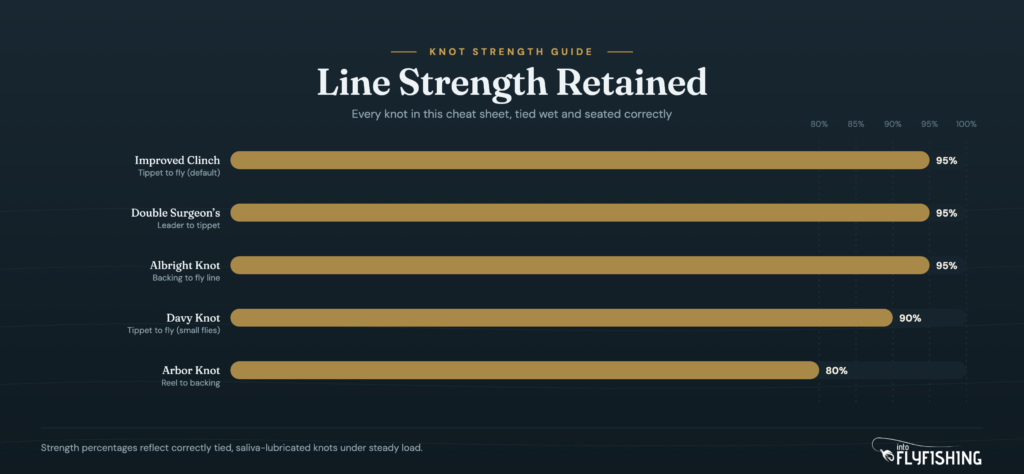
Every knot in this system, tied correctly and seated wet, retains 85 to 95 percent of your line’s rated breaking strength. The arbor knot is the lowest end of that range, around 80 percent, and that’s fine since you’ll never fight a fish on it.
The knot that fails most often in practice isn’t the weakest one on paper. It’s the one tied dry, cinched fast, or slipped through the eye crooked. Lubricate with saliva before seating any knot. Pull slowly until it closes, then tug hard once to confirm it’s seated. A knot that slips when you test it will definitely slip on a fish.
The Beginner’s Fast-Track: Three Knots to Learn First
If you’re rigging a fly rod for the first time, don’t try to learn all five knots in one session. Learn three.
Start with the arbor knot, the double surgeon’s, and the improved clinch. Those three cover the reel-to-backing connection you tie once a season and the two you’ll tie every day on the water. Buy a tapered leader with a welded-loop connection built in and skip the nail knot for now. Loop-to-loop the leader to your fly line and you’re fishing.
A palomar knot is also worth learning early if you fish with straight-eye hooks or nymphs.
Field Tips: Tying Knots When It Counts
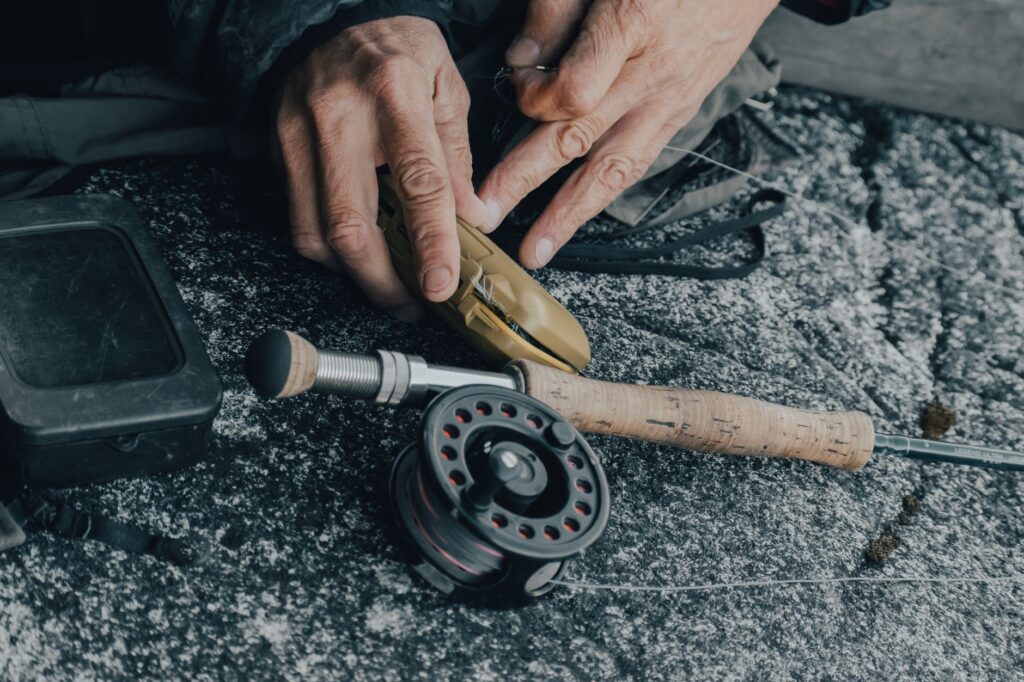
Tie knots before you get to the water, not at the bank with a fish rising. The four times I’ve broken off on fish in the past two seasons, three were on knots I rushed.
Always wet the knot before cinching. Dry friction generates heat that weakens monofilament; saliva is enough. Pull slowly to let the wraps stack before you seat the barrel. Then test it. Give the fly a hard tug and watch the knot. If it creaks or slides, re-tie it.
Keep fingernail clippers in a vest pocket for trimming tags, not a knife. You get a cleaner trim and you don’t lose a thumb fumbling with a blade in the dark. A dry dropper rig demands clean knot work at two tippet-to-fly connections, so both tips matter double there.
Fly Fishing Knots FAQ
The strongest tippet-to-fly knot in common use is the improved clinch, which retains around 95 percent of line breaking strength when tied correctly. The double surgeon’s is equally strong at the leader-to-tippet connection. No knot reaches 100 percent, and most failures come from technique rather than knot choice.
Five knots cover every connection in a fly rig: arbor knot (reel to backing), Albright (backing to fly line), loop-to-loop (fly line to leader), double surgeon’s (leader to tippet), and improved clinch or Davy knot (tippet to fly). Learn those five and you can fish anywhere.
The cheat sheet graphic on this page covers every connection point in rig order. Print this page directly from your browser; it’s formatted to print clean on a single page. Laminate it and it’ll last a few seasons in your vest.
The core five are the arbor, Albright, loop-to-loop, double surgeon’s, and improved clinch. Add the nail knot for connecting leaders to older lines without welded loops, and the perfection loop for building a loop in any leader butt. Those seven cover every real-world situation most anglers encounter.
Print It, Laminate It, Fish It
Five connections. One reliable knot per connection. That’s the whole system.
Print this page, fold it in half, and put it in your vest box. Grab it the first three or four times you rig up and you won’t need it after that. The knots become automatic faster than you’d think, and then the guide just becomes the thing you hand to someone else at the water.
Amazon and the Amazon logo are trademarks of Amazon.com, Inc, or its affiliates.
As a part of the Amazon Associates Program and other affiliate programs, Into Fly Fishing® may receive a comission if you order products through links on this website.