As an Amazon Associate I earn from qualifying purchases.
I’ve tied both of these knots more times than I can count, and I still reach for different ones depending on what I’m doing on the water. The blood knot and the surgeon’s knot both connect sections of leader and tippet material, but they work differently, they suit different situations, and picking the wrong one costs you fish. For a full breakdown of every knot worth learning, see our fly fishing knots guide.
Guides get asked this comparison constantly. My answer is always the same: both belong in your vest, and neither is universally better. What matters is knowing which one to pull out without thinking about it when a fish is rising 40 feet away.
Quick Answer
Use the blood knot when joining two leader sections of similar diameter. It seats slim and in-line. Use the surgeon’s knot when you need a fast tippet change, when your lines differ by more than one size, or when cold hands make fine wraps difficult. Both are close to 100 percent line strength when properly tied.
What the Blood Knot Actually Does
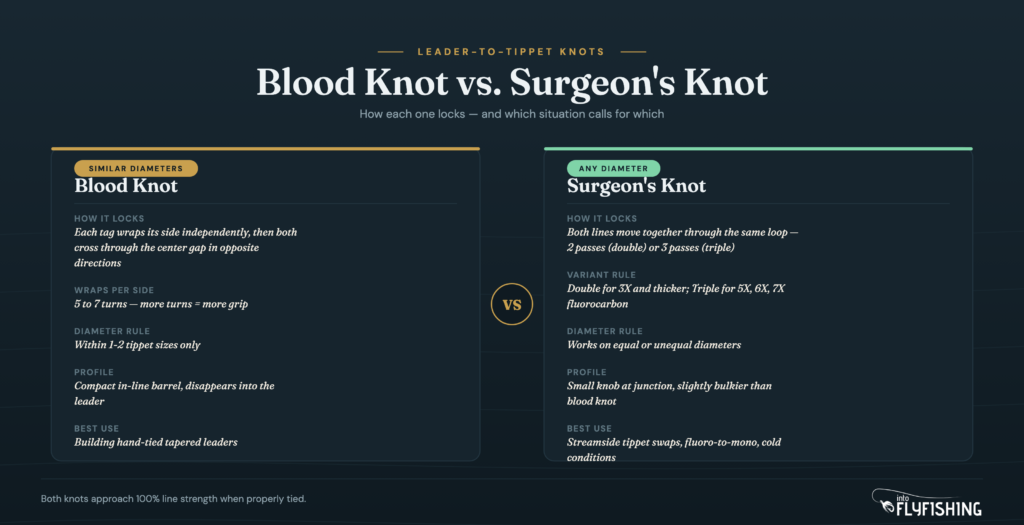
The blood knot connects two lines by wrapping each one independently around the other. You overlap the lines, wrap one tag end around the standing line five to seven times, tuck that tag through the center gap, then do the same thing in the opposite direction with the other tag. Both tags end up passing through the same center gap, moving in opposite directions. That opposition is what locks the knot.
The result is a tight, compact barrel that sits exactly in line with the leader. No bulk, no angle, nothing sticking out. That slim profile is why the blood knot is the standard for hand-built tapered leaders. A knot that adds even a small lump at a section junction can cause the leader to hinge there, killing turnover at the fly end.
The trade-off is that the blood knot needs similar line diameters to hold reliably. Within one or two tippet sizes works well. Push beyond that and the wraps on one side grip less than the other, and the knot either slips or fails outright.

What the Surgeon’s Knot Actually Does
The surgeon’s knot works on a completely different principle. Both lines move together the entire time. You overlap them side by side, then pass both strands through the same loop together, treating them as one unit. For a double surgeon’s, you make two passes through the loop. A triple surgeon’s adds a third. Wet the knot, pull all four ends at once, and it cinches down fast.
Because neither line wraps independently, the knot self-adjusts to different diameters. The stacked-overhand structure grabs both lines equally regardless of whether they match. That’s why it handles fluorocarbon-to-monofilament transitions and large diameter gaps that would make a blood knot fail. Our step-by-step surgeon’s knot video covers the full tying process if you want to see the hand positions.
The surgeon’s knot is not as slim as the blood knot. It creates a small knob at the junction rather than an in-line barrel. For tippet swaps in the field, that does not matter. For the butt and mid sections of a knotted leader where profile affects how the whole leader turns over, it matters a lot.
Blood Knot vs Surgeon’s Knot: Side by Side
The core difference comes down to mechanics: one line wraps independently and the knot locks by opposition at the center, while the other bundles both lines together into a shared loop structure. Those two approaches produce different profiles, different diameter limits, and different tying speeds.
The table below lays out the direct comparison across the details that actually matter on the water. After reviewing it, the decision for most fishing situations becomes straightforward.
| Feature | Blood Knot | Surgeon’s Knot |
|---|---|---|
| Turns / passes | 5-7 per side, tags cross at center | 2 passes (double) or 3 passes (triple) |
| Profile | Compact barrel, in-line | Slightly bulkier, small knob at junction |
| Diameter range | Similar (within 1-2 tippet sizes) | Equal or unequal diameters |
| Speed to tie | Moderate, requires fine manipulation | Fast , both strands move as one unit |
| Cold / low light | Harder , small independent wraps | Easier , no independent strand work |
| Best for | Leader building, similar sections | Tippet swaps, fluoro-to-mono, field use |
| Variant rule | N/A , turns (5-7) are the only variable | Double (3X+), Triple (5X and finer) |
When to Use the Blood Knot
Building a hand-tapered leader
A knotted leader built from scratch requires multiple sections joined in sequence, usually starting around .021 or .023 inches at the butt and tapering down to 5X or 6X at the tippet. Each junction has to transfer energy down the leader without creating a hinge point. The blood knot’s in-line barrel profile handles this. The knot disappears into the leader instead of sticking out from it.
If you want to understand how those sections are sized and why the taper matters, the leaders and tippet guide covers the full breakdown. For leader building, the blood knot is the standard choice, and it earns that status because of what the slim profile does for presentation.
Matching similar-diameter sections
The blood knot works reliably when you’re connecting lines within one to two tippet sizes of each other. Going from 2X to 3X, or from 3X to 4X, falls well within that range. The wraps on both sides grip with similar tension, and the knot seats correctly.
Going from 1X down to 5X in one junction is too much of a diameter gap for the blood knot to handle. In that case, you need a knot designed for big diameter differences, like the slim beauty knot. Using the wrong knot for that kind of jump is a reliable way to lose a fish at the net.
When to Use the Surgeon’s Knot
Joining different-diameter lines
The surgeon’s knot handles diameter gaps that would cause the blood knot to fail. Fluorocarbon tippet joined to monofilament leader is a common example, and the material difference adds another variable on top of the diameter difference. Because both lines move through the shared loop together, the knot grips each one regardless of size mismatch.
For fine tippets, a triple surgeon’s knot is the right call. At 5X, 6X, and 7X, fluorocarbon in particular tends to slip under tension with only two passes through the loop. The extra wrap on a triple surgeon’s prevents that. The triple surgeon’s knot guide shows exactly where that third pass changes the knot’s behavior.
Fast field repairs in any conditions
The surgeon’s knot is faster to tie than the blood knot, and the margin gets bigger when conditions get harder. Cold hands, low light, and wind all slow down the independent wrapping the blood knot requires. The surgeon’s knot only asks you to hold two lines together and pass them through a loop. The steps are simple enough to execute by feel.

For swapping tippet sections during a hatch, that speed is the whole point. You are not building a precision leader at a bench. You are changing from 5X to 6X because the fish are refusing and you have a limited window. The surgeon’s knot gets you back to fishing faster, and that is the only thing that matters in that moment.
Which One Should You Carry?
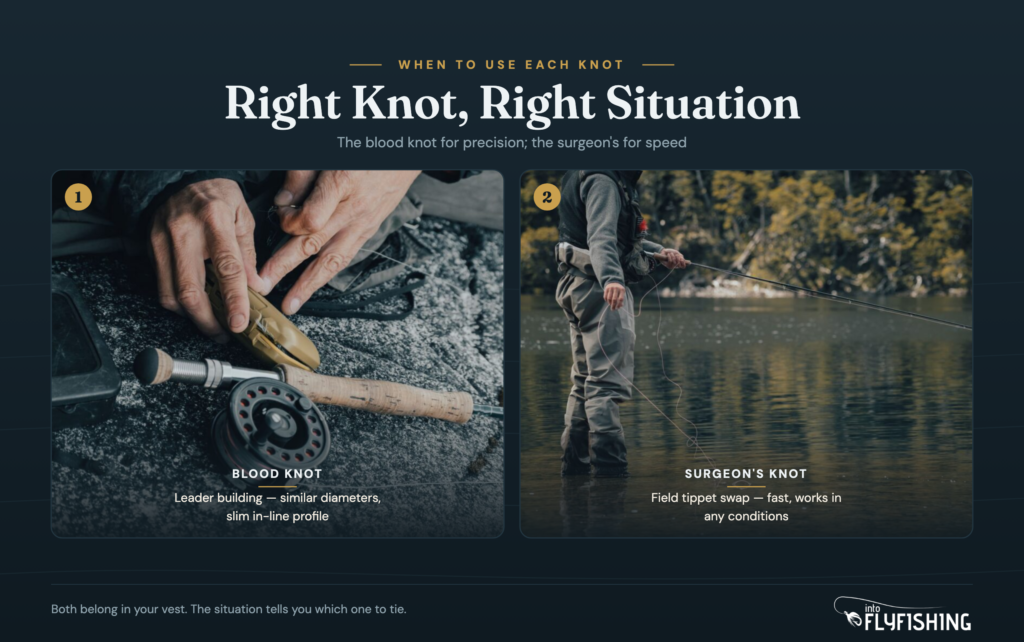
Carry both. That is the direct answer. The blood knot belongs in your process when you are building a knotted leader from scratch, specifically for the butt and mid sections where the slim in-line profile keeps the leader turning over correctly. The surgeon’s knot belongs in every tippet swap in the field, for fluorocarbon-to-mono connections, and for any time conditions make precise wrapping impractical.
The strength question comes up constantly and it deserves a straight answer. DuPont engineers who tested both knots found that the relative strength between the two varies more based on who is tying them than on which knot is being tied. Both approach 100% line strength when executed correctly. Tying proficiency matters more than the knot choice itself. Practice both until you can tie them reliably without looking.
If you are still dialing in your full setup beyond leader connections, our guide to the best fly lines covers what to match with different leader configurations and fishing situations.
The guides who reach for the blood knot for leader building and the surgeon’s knot for field tippet changes are not overthinking it. They learned where each one fits and stopped debating it. That’s the right place to land.
Frequently Asked Questions
Both knots approach 100% line strength when tied correctly. DuPont engineers found that strength differences between the two vary more by who is tying them than by which knot is used. Focus on tying proficiency with whichever knot you choose.
Use the blood knot when joining lines within one to two tippet sizes of each other. It's the standard choice for building hand-tapered leaders because its slim, in-line barrel profile prevents hinging at section junctions. Avoid it when diameter differences are large.
The triple surgeon's knot passes both lines through a shared loop three times to prevent slipping, and handles different diameters well. The blood knot wraps each line independently around the other and locks by opposition at the center gap. The blood knot produces a slimmer profile; the triple surgeon's is faster to tie and more reliable with mismatched diameters or fine fluorocarbon.
Yes, and for fluorocarbon at 5X, 6X, or 7X, use the triple surgeon's knot rather than the double. Fluorocarbon tends to slip under tension with only two passes through the loop at fine diameters. The extra wrap on the triple surgeon's prevents that slipping and keeps the knot seated under load.
Pick the right knot for the right job and tie it until it’s automatic. Blood knot for leader building where the slim profile keeps the whole system turning over. Surgeon’s knot for tippet changes in the field where speed and reliability under variable conditions matter more than profile.
Wet every knot before seating it. Pull the standing lines apart slowly until the barrel or loop cinches fully. Trim the tags close. Those three steps apply to both knots and are where most failures actually happen.
Amazon and the Amazon logo are trademarks of Amazon.com, Inc, or its affiliates.
As a part of the Amazon Associates Program and other affiliate programs, Into Fly Fishing® may receive a comission if you order products through links on this website.