As an Amazon Associate I earn from qualifying purchases.
I made every one of these mistakes. Some of them more than once. My first few seasons on the water I spent a lot of time wondering why the guy upstream was landing fish and I was not, and the answer was usually one of the ten things below.
None of these are complicated to fix. They just take someone pointing them out, which is what this post is for. Work through them in order because the first few are the ones that blow your chances before the fly ever hits the water.
| Mistake | Why It Costs You Fish | The Fix |
|---|---|---|
| Wading in first | Spooks holding fish before you cast | Read the pool from the bank, then enter |
| Too many false casts | Fly rod movement alarms trout | Two false casts max; shoot the line |
| Casting too far | Loss of line control and drag | Fish the 15-25 ft zone first |
| Drag on the fly | Unnatural movement = refusal | Mend upstream right after the cast |
| Heavy tippet in clear water | Trout see the leader and refuse | Drop to 5X or 6X on flat clear runs |
| Skipping knot checks | Biggest fish break off on the strike | Pull test every knot before you fish |
| Wrong strike timing | Dries: pull the fly away; nymphs: miss the take | Say "fish" before lifting on dries; react instantly to the indicator |
| Fishing the riffle | Most trout hold in the seam, not fast water | Target the edge between fast and slow current |
| Rushing after a rise | Cast wake puts the fish down | Wait, observe, plan, then make one good cast |
| Wrong rod for the water | Overpowered on small streams; too light for big rivers | Match rod weight and length to the water type |
1. Wading Into the Best Water Before You Fish It
I did this for two full years. The pool looked perfect, I walked straight into the tail of it, and the fish that had been holding there scattered into the faster water upstream where I could not reach them.
Trout in shallow water feel your footsteps through the riverbed. The vibrations from wading boots carry 20 to 30 feet in low water, and every fish in the pool knows you are coming. Before you step in anywhere, stand on the bank and look. Polarized sunglasses help a lot. Pick your casting angle from dry land, figure out where the fish are likely to be, and plan your approach so you can reach those spots without wading through them first.

Learning how to read water for trout from the bank is probably the single biggest skill shift a new angler can make. You lose nothing by waiting an extra two minutes to plan your entry, and you keep all the fish from spooking before your first cast.
When you do wade in, move slowly. Shuffle your feet along the bottom instead of picking them up and setting them down. The slower you move, the less vibration you send out, and the more fish you’ll find still sitting where they were when you got there.
2. False-Casting Too Many Times
Count your false casts next time you’re on the water. Most beginners are at four, five, six per cast. Every one of those false casts sends the rod through the air above the water where trout can see it, and every one of them costs you time when the fly could be on the water instead.
Two false casts is the standard. Three if you need to add some distance. Any more than that and you are actively working against yourself. The fly only catches fish when it is on or in the water, not when it is in the air.
The other thing extra false casting does is tire out your arm and throw off your timing. A tight loop from a quick two-cast sequence drops the fly more accurately than a loose, rushed loop from six false casts in a row. Slow down the casting stroke, let the line load the rod properly, and get the fly on the water faster.
If you are struggling with the cast itself, our guide on How To Cast a Fly Rod covers everything you need, including the common timing errors that cause most beginners to over-false-cast.

3. Trying to Cast Too Far
A beginner sees a rising fish 50 feet away and tries to reach it. What happens is a pile of line, a dragging fly, and a spooked trout. The fish they missed in the 20-foot zone in front of them is the one they should have been fishing.
In most trout streams, the fish are not as far away as you think. A run or riffle with good holding water probably has fish working 15 to 25 feet from where you’re standing. At that distance you have direct control of the line, you can mend effectively, and you can set the hook without taking up six feet of slack first.
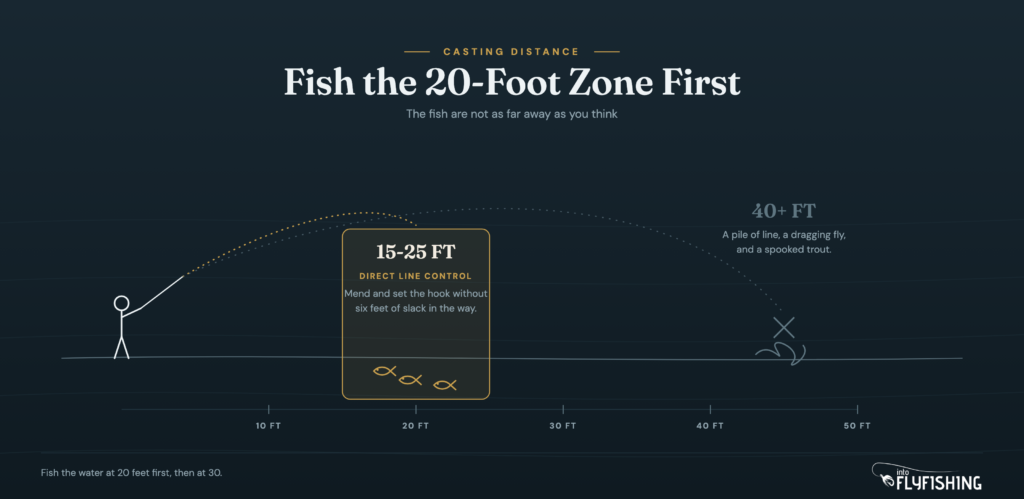
Pick a spot you can realistically cast to and fish it thoroughly before moving to the next. Wade upstream slowly, fish the water at 20 feet first, then at 30. You will be surprised how many fish are right in front of you once you stop trying to reach the far bank.
4. Letting the Fly Drag Instead of Mending
Drag is the number one reason trout refuse a fly. A dry fly skating across the surface or a nymph swinging on a tight line does not look like anything that lives in a river, and trout know it immediately.
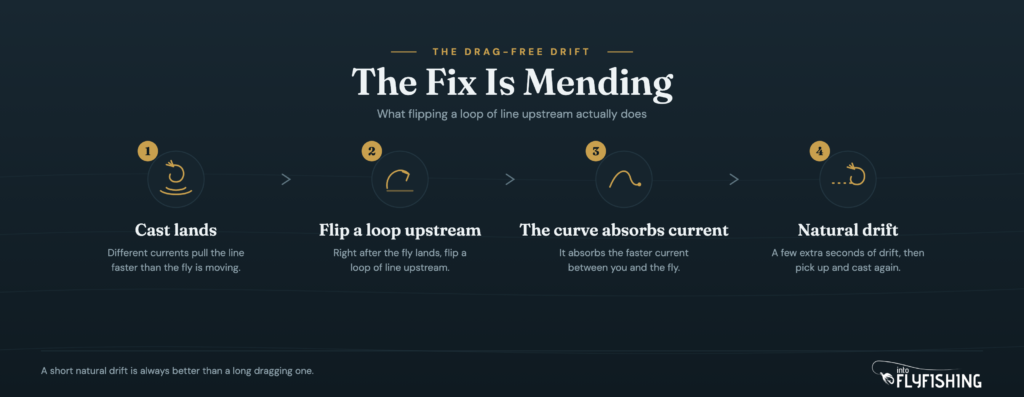
Drag happens because different currents between you and the fly pull the line faster than the fly is moving. The fly swings in an arc instead of drifting naturally. You can see it happening on a dry fly; on a nymph it is invisible, which makes it worse.
The fix is mending. Right after the fly lands, flip a loop of line upstream. That upstream curve absorbs the faster current between you and the fly, buys a few extra seconds of natural drift, and dramatically increases your hookup rate. If the drift goes 10 feet and drag sets in, pick up and cast again. A short natural drift is always better than a long dragging one.
Understanding fly fishing terminology around mending and drift will help you understand what to watch for and how to correct it on the water.
5. Using Tippet That’s Too Heavy for Clear Water
I grew up fishing 3X tippet because that was what came with my first kit. I caught fish, but not as many as I should have. When I finally dropped to 5X on a flat, clear tailwater, the difference was immediate.
In low, clear water, trout can see the tippet. A heavy leader hanging above a size 16 dry fly does not fool a pressured fish. The rule I fish by is to go at least two sizes lighter than you think you need. In most freestone streams with average visibility, 4X or 5X is the right starting point. On spring creeks and tailwaters with spooky fish, 6X is not overkill.
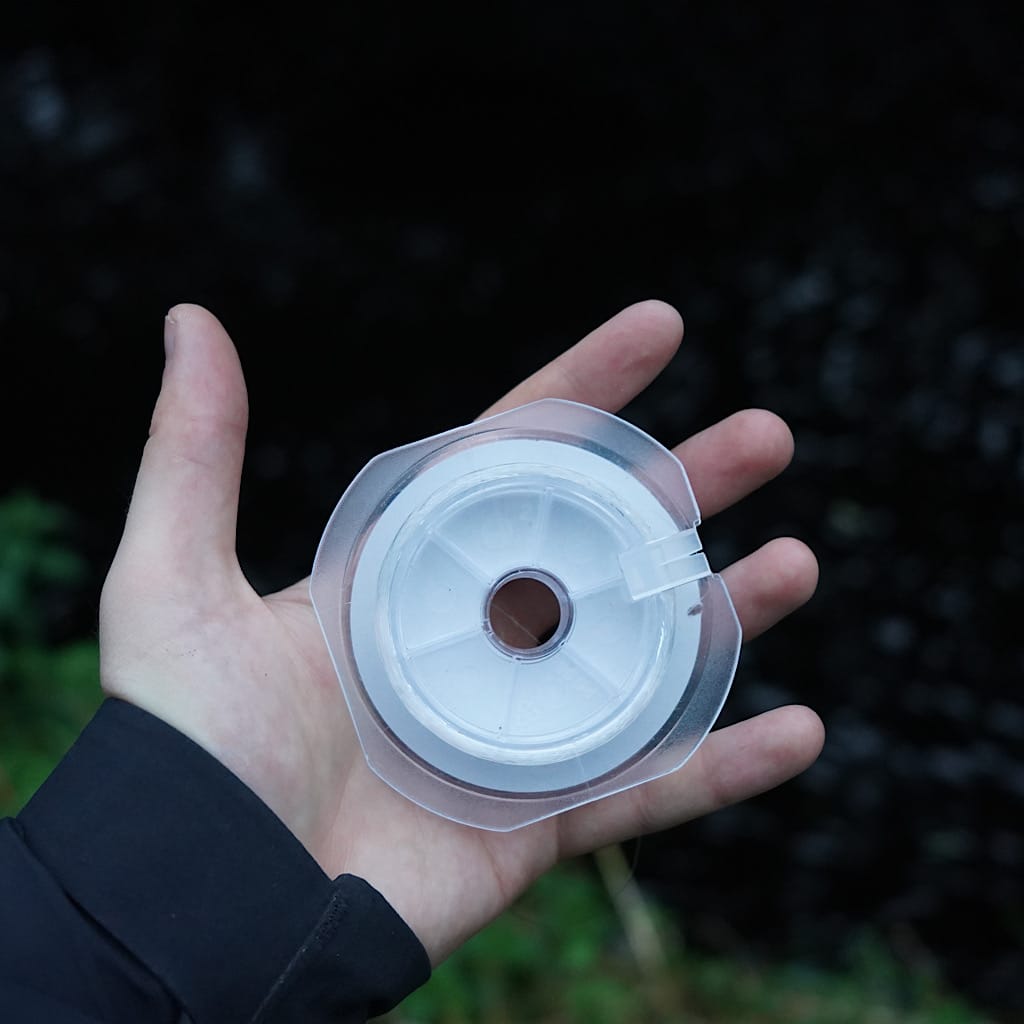
Our full breakdown on fly fishing leaders and tippet covers how to match tippet diameter to fly size and water clarity. The short version: the clearer and slower the water, the lighter you should go.
The tradeoff is that lighter tippet breaks more easily on the strike and on big fish. That is why knot quality matters even more when you go light, which brings us to the next mistake.
6. Skipping the Knot Check
The best fish I ever lost was a brown trout in a spring creek in Montana. The clinch knot I had tied in the parking lot was only halfway seated and had been sliding toward the eye of the hook for three hours. When the fish hit, the knot blew, and that was that.
Before you make your first cast, pull hard on every knot in the system. Clinch knot to the fly, tippet-to-leader connection, and if you tied any other junctions, test those too. A knot that fails the pull test in your hand is one that would have failed on a fish.
The improved clinch knot is the standard for attaching a fly. Wet the knot before you pull it tight. A dry clinch knot creates friction heat that weakens the tippet. Moisten it, seat it down to the eye, and trim the tag end to about 2mm. Then test it.

Check the fly-to-tippet knot any time you hit a rock, a branch, or a fish. Tippet weakens at the knot each time it absorbs an impact, and a knot that tests fine in the morning can be marginal by afternoon if you have been casting in tight quarters.
7. Striking at the Wrong Moment
New dry fly anglers strike too early. They see the rise, yank the rod, and pull the fly out of the fish’s mouth before it has closed. The trout gets a faceful of leader and disappears. New nymph anglers do the opposite. They hesitate, the fish spits the fly, and the indicator drops back flat before they have reacted.
For dry flies, slow your strike down. When a trout rises to your fly, say the word “fish” before you lift the rod. That half-second delay gives the trout time to turn down with the fly in its mouth, and the hookup rate on dries goes way up. It feels wrong at first because every instinct says to strike immediately, but that instinct is what pulls the fly away.

For nymphs under an indicator, you want the opposite: react to any movement of the indicator, even tiny hesitations and sideways drifts. Trout take and spit a nymph fast, often in under a second. If you wait until you are certain, you have already missed it. Set the hook on any unusual indicator movement and sort out whether it was a fish or a snag after the fact.
8. Fishing the Riffle and Ignoring the Seam
Beginners walk up to a riffle and start casting into the fast broken water in the middle. The fish are not there. They are in the seam.
The seam is the boundary between fast water and slow water. On a river with a defined current, there is usually a visible line where the two speeds meet, sometimes marked by a foam line or a change in the surface texture. Trout hold on the slow-water side of that line, where the current brings food to them without requiring them to fight the full force of the fast water to stay in position.
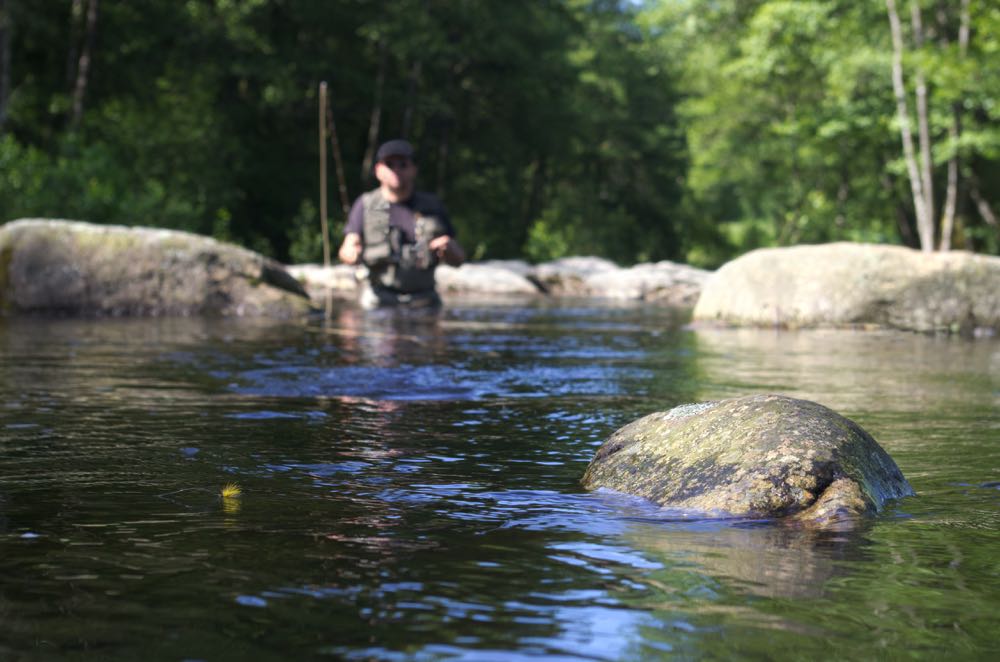
Cast to the seam. Put the fly on the slow-water side or right on the boundary, and let it drift downstream along that line. The riffle itself holds some fish at certain times, particularly early in a hatch when fish are chasing emergers up through the water column, but the reliable holding water is almost always the seam, especially on a river you do not know well yet.
This is the core of reading water: identifying where fish are expending the least energy to get the most food. Riffles and runs both have seams. So do pools, along the edges where the main current starts to slow. Fish those edges first.
9. Rushing After a Rise Near You
You’re standing 30 feet downstream of a fish that just rose, twice, to something small and tan. Your instinct is to immediately cast to it. That instinct is wrong.
The problem is the cast. Even a clean cast sends a shadow across the water and creates micro-disturbance on the surface when the leader lands. If the fish was already looking up at the surface, it will notice. Any cast that lands sloppily, or any approach that sends a wake across the pool, puts the fish down for two to five minutes.
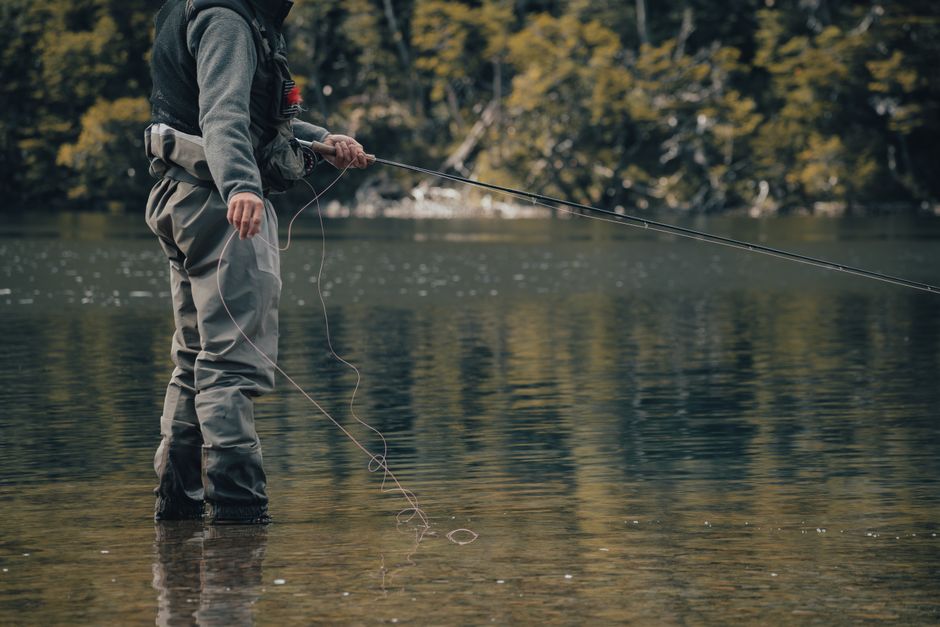
Wait a moment after spotting a rising fish. Figure out what it is eating before you do anything else. Look at the surface for insects, check the leader length and fly you have on, and plan where your fly needs to land relative to the fish’s feeding lane. Then make one cast, a good one, to the right spot. A single accurate cast is far more effective than three quick ones thrown in a hurry.
If you are going to move position, do it carefully and without wading. Walk along the bank if you can. The rule is simple: the fish does not know you are there yet, so do nothing to change that.
10. Fishing the Wrong Rod for the Water
A 9-foot 5-weight is the standard beginner trout rod, and it is a great all-around choice, but it is not right for every situation. New anglers often buy one rod and fish it everywhere, which works fine until the water does not match the tool.
Small mountain streams need a shorter, lighter rod. A 7.5-foot or 8-foot 3-weight or 4-weight gives you the accuracy to drop a fly under overhanging brush where a 9-foot rod would catch a branch on every backcast. A short rod on a tight stream is easier to roll-cast with and keeps your fly presentation tight in close quarters.
Big western rivers, or any situation where you’re throwing streamers or weighted nymphs into heavy current, want something more powerful. A 9-foot 6-weight handles heavier flies, cuts through wind, and gives you more control on a big fish in fast water.
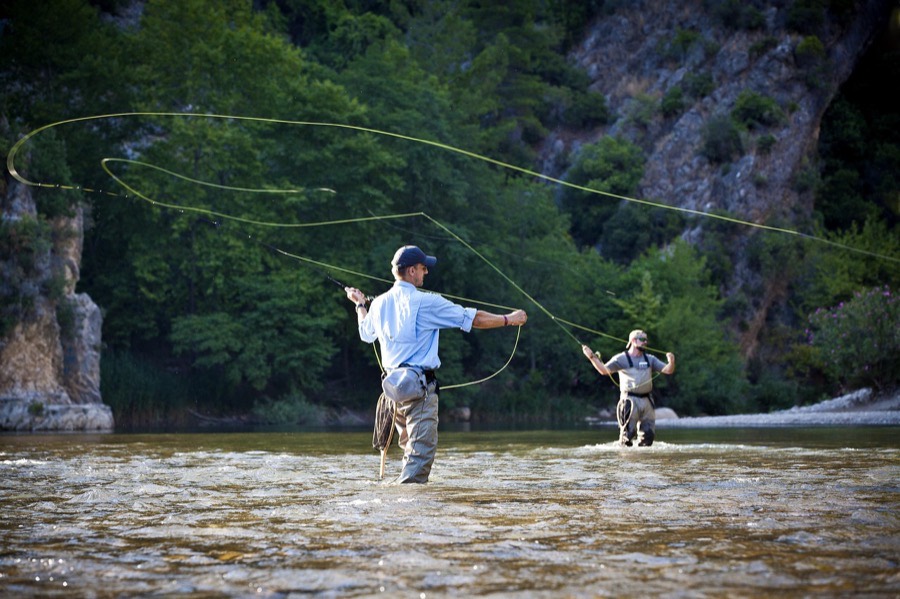
If you’re just starting out and buying your first setup, a 9-foot 5-weight is still the right call. It handles most trout water well enough to learn on without boxing you into one style of fishing. Our full breakdown of the best beginner fly rods covers the top picks at every budget, including the setup options that give you the most flexibility when you’re new. Pairing it with a quality fly line makes a bigger difference than most beginners expect. Understanding how much fly fishing costs to start helps set realistic expectations before you shop, too.
Pick one mistake from this list and make it your focus the next time you’re on the water. You don’t need to fix all ten at once. Most of your improvement will come from the first three or four, because the early ones are the ones that blow your chances before the fly is even fishing. Start with the approach and the casting stroke, and the rest gets easier.
Frequently Asked Questions
In fly fishing, the 80/20 rule means that roughly 80% of the fish hold in 20% of the water. That 20% is almost always the seams, the confluence points where fast current meets slow, the heads of pools, and the undercut banks. Identify that productive 20% first and spend your time there instead of fishing water that is unlikely to hold anything.
The drag-free drift is the one thing that changes results faster than anything else. The fly needs to move the way a natural insect would move on or in the water, with no drag from the line pulling it off course. Getting a clean drift requires mending, choosing the right casting angle, and managing slack in the line.
The basics are learnable in a day or two. You can make a functional cast and catch fish within a few hours of practice. Getting good at it, reading water well, matching hatches, and presenting a fly cleanly in complex currents, takes longer. Most anglers are comfortable on easy water within a season and still learning something new five years in.
One full season of regular fishing gives you the core skills: a workable cast, basic knots, and the ability to read a pool and identify where fish are likely to hold. Two to three seasons and you start to understand hatches, current seams, and fish behavior well enough to adapt on the water.
Amazon and the Amazon logo are trademarks of Amazon.com, Inc, or its affiliates.
As a part of the Amazon Associates Program and other affiliate programs, Into Fly Fishing® may receive a comission if you order products through links on this website.