As an Amazon Associate I earn from qualifying purchases.
In this Scott Wave Fly Rod review, we’ll take a deep look into the componentry, construction, and real-world use to see if this is the right rod for you.
I’ve been fly fishing for nearly 35 years and have been a professional guide for the last 15. I’ve seen a lot of rods come and go and watched/experienced them take a lot of use and a lot of abuse over the years. I also used to own the Wave’s predecessors, the Scott Flex and the Scott Tidal.
In my humble opinion, the Scott Flex was maybe the best-performing mid-priced rod I’d ever used. With that in mind, I was extremely excited to get my hands on the newer Scott Wave 9′ 6wt to see how it stacks up against its former self. The Wave also blends a bit of the old salt-oriented Tidal into the mix.
I’ve gotten a bit of use out of my new Scott Wave rod this week. To make a fair/honest review, I fished, ran dryland casts in a few different situations/scenarios, and ran measurements/tests. Here’s what I came up with…
Why Trust My Scott Wave Fly Rod Review?
Our reviews are only based on real-world experience. We’re not raiding the internet to cherry-pick information from others. This is a real-life, self-experienced interaction and critique of the equipment in question.

As a lifelong fly fishing enthusiast and as a professional guide, I get a lot of use and abuse on my equipment in a very short period. Not only do I experience said equipment myself but, as a guide, I get to see how others experience and use the same equipment and how things will hold up over time.
Scott Wave Review: How I Reviewed & Tested The Rod
Of course, Scott lists the basic stats of the rod on their website. That’s great information but we’ll always measure and test these stats ourselves as well.
Dryland casting is also a part of the repertoire. Getting a feel for the casting action of a rod in a controlled setting like the local baseball field allows for easy execution/measurement of different tests.
Finally, this rod has seen plenty of action on the river too. No controlled test can compare to real-world, on-the-water use. I was able to put myself into different casting situations with different distances, different obstacles, and different flow rates.
For new rods, I like to fish/test multiple setups…small dry flies (single/double), dry dropper (usually a Chubby Chernobyl and a bead-head nymph), an indicator nymph rig (two nymphs), and a streamer or two.
I was also privileged enough to find a few fish to battle. I now feel like I have a pretty good grasp on this rod and its performance/capabilities.
Scott Wave Pros
The Scott Wave line of rods is designed for all-water use, meaning it’s at home on the river, on the lake, or the saltwater. With that in mind, it’s crafted with a solid backbone and makes casting heavy flies over long distances much less of a chore.
From casting a Chubby Chernobyl with a Pat’s Rubberleg dropper, a heavy indicator rig, or a sinking line with a Peanut Envy on the 6 or 7 wt, to battling angry tarpon with the 12wt, the Scott Wave can handle.
Very Powerful Rod
Off the bat with the first cast, the power of this rod is evident. It’s very apparent that handling any fly, even big articulated streamers, won’t be a problem.
This will also show up in a big way when battling feisty smallies or trying to torque a big jack crevalle to the side of the boat.
Great Recovery
Scott uses some proprietary methods/builds to enhance their rods. Their ReAct technology means energy-robbing vibrations are dampened quickly. This is noticeable in the feel of the rod almost immediately.
During the cast, it feels like there’s no wasted energy: no sideways wobble, no torsional “wandering.” Everything feels crisp and true.
On the final forward push, the recovery of the rod feels nearly immediate. As the fly/fly line shoots forward, there is no perceptible wiggle, wobble, or waving to take away from the forward trajectory of your shot.
Longevity
I can’t say realistically with this particular rod, but every Scott I’ve had before has been beaten up but still performs. I’ve pushed my previous Scott rods past the point where others would fail and they keep on going.
The Wave has similar components and the same natural finish as its predecessors, and I suspect this rod will be no different. Of course, an update down the road will (more than likely) confirm this suspicion.
Scott Wave Cons
While there’s a lot to like about this rod, and I do mean a lot, there will be inherent weaknesses. I’ve found that fly fishing is rather reductive in general. The Wave is no different. It’s meant to excel in some areas/scenarios which means it won’t do so well in others.
Not Great for Delicate Presentations
You can’t really be a sniper if you’re firing a cannon. And it’s kind of the same with the Wave. It’s a powerful rod. Fishing really small dries isn’t really its forte.
It definitely can be done. Its supple tip does help out. And that’s not to say you can’t land a bigger fly with this rod without being ridiculously splashy.
This is a 6-12wt lineup with power behind it. If you want to delicately fish midge and trico dries, look elsewhere.
Over 70ft Wasn’t as Smooth as I’d Like
Casting this rod, at least the 6wt, was really, really great between 30 and 60 feet. It felt nearly effortless.
However, without double hauling with the line hand and relying only on the rod for distance casting, the stiffness of the rod may be lending to the drop in casting feel at long distances.
Not to worry…anyone looking to pick this rod up should probably know how to double haul anyway. Employing the double haul on long-distance shots was the key to punching big lengths of line.
What’s In The Box?
When you order yourself a Scott Wave Fly Rod, here’s what shows up at your door:
Rod Tube
The Scott Wave rod tube is pretty standard for a “mid-tier” rod. It’s a black Cordura-covered hard case with the Scott logo stitched onto the side and the model sticker on the zippered end.
What’s great about this “mid-tier” rod’s case is, unlike other mid-tier rods with their Cordura cases, the Scott Wave comes with a real rod sock with dividers for each of the four rod sections. No simple, stitched-in dividers for the Wave!
The Rod
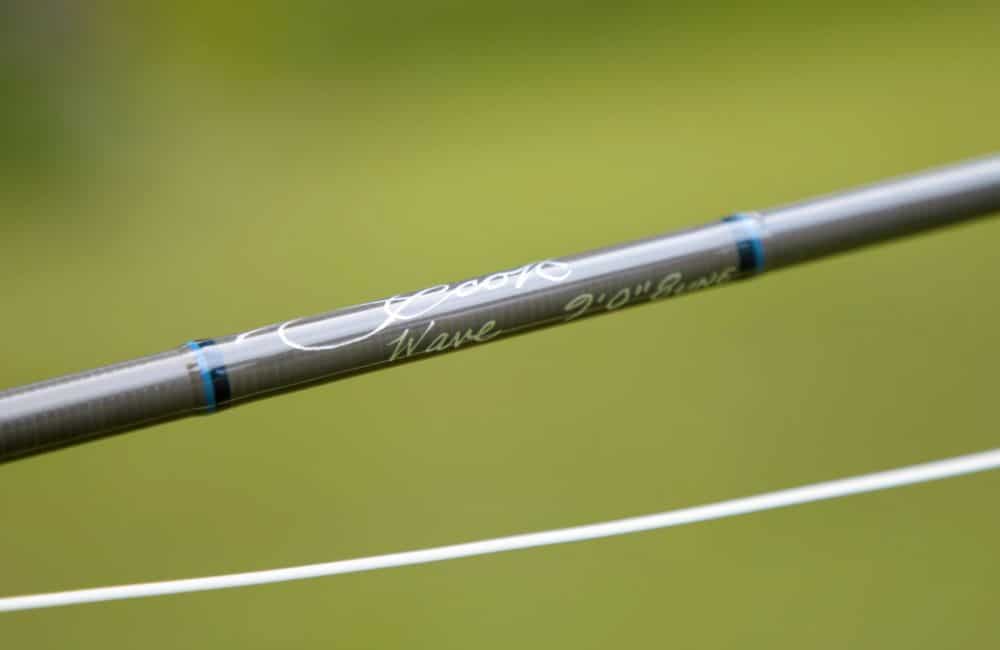
The Rod itself is a very attractive rod. The four pieces are all well finished with the traditional Scott “natural finish.”
Many like it and many don’t, but Scott continues to refuse to sand/rip the naturally wrapped/ribbed look of their blanks.Scott continues to do so to maintain strength and to rid accidental flat spots while sanding.
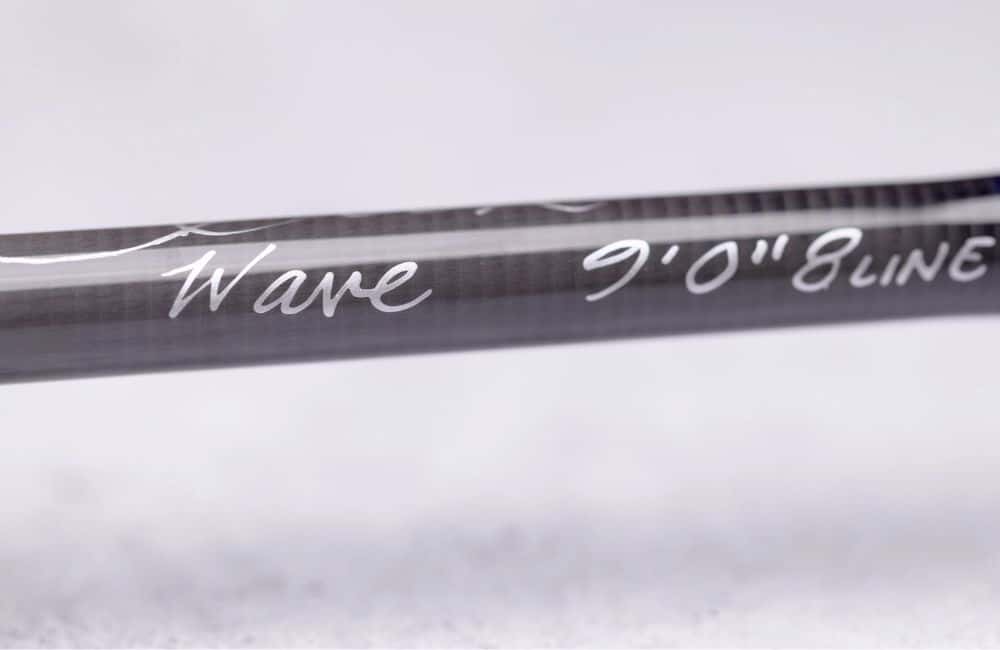
The finish is further enhanced with a semi-glossy “FiberFuse” resin that permeates the outer fibers to add strength and maintain the rod’s integrity.
The blanks are a deep charcoal color with navy blue and royal blue wrapping. It’s an attractive look which makes the lighter colored, soft-grip, full-wells cork handle really pop.
The handle is comfortable and clean and all rods are fitted with a cork fighting-butt. The Butt is tipped in a high-density black foam for comfort and longevity.
Scott Wave Specs
Understanding the rod specs will give you a better picture of what the rod can handle and what situations the rod will excel in. This will also show how the rod can be expected to perform.
- Category: All-water (fresh and salt)
- Available Lengths & Weights: All are 9ft rods in weights 6-12
- Action: Fast
- Pieces: 4
- Blank Material: Natural Multi-modulus fiber with “Fiberfuse” hard finish
- Measured Weight: 3.5 oz
- Stripping Guides: Hard chrome w/ ceramic inserts
- Snake Guides: Hard chrome
- Reel Seat: Blue carbon fiber…very cool looking!
- Handle Material and Style: Double-wells cork. Fighting butts with black foam tips are present on all models.
- Rod Tube: Cordura-covered hard case with a label on the zipper end
- Rod Sock: Black polyester rod sock with section dividers and “Scott” embroidery.
- Price: $675
Scott Wave Fly Rod Review: How The Rod Feels
Rod feel varies greatly from brand to brand, series to series. Here’s what you can expect from the Aventik Riverbend fly rod series:
Overall Weight
There were no listed weights for these rods on the Scott website. The 9′ 6wt model I reviewed weighed in at 3.5 oz.
Swing Weight
Again, nothing was listed for swing weight. However, the feel of the rod is quite light, fast, and has some incredible recovery.
Power
Scott rods are synonymous with power. Even their glass rods seem to have more power than the rest. My review of the Scott Wave 9ft 6wt proved no different.
The backbone on this rod is very noticeable without being a nuisance. It’s powerful without being brutish. There’s good punch while maintaining feel.
Action
Scott lists the action on the Wave series as fast. In performing this review of the Wave, I would definitely concur. The flex point is more toward the tip with the majority of the butt/handle section feeling rather stiff and powerful but, again, not lacking in sensitivity.
Presentation
I keep stressing the power of this rod. However, the presentation quite good too.
With the power of the blank, distance is easily gained, especially in the 30-60ft range (see casting distances below). The smooth flex and tip feel then aid in turnover and presentation.
Of course, this rod isn’t typically going to be used as a small dry fly rod. Fly entry into the water can be a touch ploppy if you’re not timing the final forward cast/loop opening perfectly…but those fishing this rod are most likely fishing bigger, heavier flies/rigs anyway.
For streamer/saltwater presentation, the rod feel on the retrieval is solid and stable…from those slower crab crawls or shrimp pops to bigger, aggressive articulated streamer rips.
For big dries or nymph rigs, mend control is quite noticeable. It’ll save you tons of energy in a day and your arm won’t go numb after a couple of hours of high-sticking.
Tip Sensitivity
My review of the Scott Wave rod shows no lack of tip sensitivity. I’ve cast plenty of power-laden rods that were overly brutish all the way through the tip.
That’s not the case with the Scott Wave, however. There’s plenty of good feel in the tip of this rod without feeling too soft or noodly. The Wave tip hits the sweet spot between good feel and easy accuracy/turnover.
The Wave’s blank (and flex) feels seamlessly tapered from the powerful butt section, through the mid rod and main flex point, all the way to the rod tip.
Scott Wave Warranty
Scott’s limited lifetime warranty takes care of your rod-injury worries. Of course, this covers defects and workmanship. Uh-ohs can be made well with a reasonable fee.
Casting The Scott Wave
The build and material characteristics of each rod will determine how it feels and casts at different distances. In my Scott Wave 9′ 6wt fly rod review, here’s what I found:
0-20 Feet
For short distances, the stiffness of the butt section does hamper the cast a bit. There’s just not enough line weight outside the rod to feel/flex the cast much at all.
Not to worry…for short distances, this rod excels at roll casting and bow-and-arrow shots.
20-40 Feet
20 to 40 feet is a breeze. There’s now enough line weight outside the rod tip and the cast feels powerful, accurate, and in control.
40-60 Feet
40-60 feet is still fantastic. Casting the Scott Wave (at least my 6wt model) seems rather effortless in the 20-60ft range.
60+ Feet
60-70 feet still feels extremely solid. In fact, I’d say that the sweet spot for distance on this rod is anywhere from 20 to nearly 70 ft.
After 70 ft, the rod stiffness seemed to hamper the casting feel a bit. Now, this was with a lightweight purely casting setup and without double hauling the line (as I wanted to feel the rod do the work itself).
Larger/heavier flies will add weight to counter this dip in the casting feel. Also, once I added the double-haul method to the cast with my line control hand, the rod came back to life.
Other Rods That Compare To The Scott Wave
If you’re shopping for a new rod and considering the Scott Wave, you might also be looking at the Sage Maverick or the Orvis Recon.
The Sage Maverick is a solid, salt-water-specific offering. Its cobalt blue blank has a smooth sanded finish and delivers some decent casting and fighting power.
The Maverick will have a bit more flex/feel in the cast stroke and comes in at the same price as the Scott Wave.
The Orvis Recon is another option that has both a freshwater and a saltwater specific option. The Recon too has the smooth sanded finish you’ll find on most rods. With improved stiffness and dampening, this is also a solid choice.
If you’re looking for something with power and backbone without sacrificing feel, I’d suggest staying with the Scott Wave.
Who is the Scott Wave Fly Rod For?
The Scott Wave fly rod series is best suited for intermediate and advanced casters who want a powerful rod that can handle heavier flies, battle tough fish, and enjoys pursuits in the freshwater and/or the saltwater.
That’s not to say a beginner shouldn’t get the Wave. However, a newer fisher person might benefit from a less-stiff rod with a mid to mid-fast action as it’s easier to find the sweet spot in the cast.
From stripping streamers for smallmouth bass or hook-jawed browns to punching permit crabs through gale-force winds on the salt flats, from heavy nymphing for trout or steelhead to pounding the mangrove edges for tarpon, the Wave has the power and feel to get it done.
Scott Wave Review: My Personal Thoughts
I’ve been eagerly awaiting the arrival of this rod for some time. Not to beat a dead horse but the previous Scott Flex lineup was a stellar one and I’ve missed it dearly since its termination.
When the Wave was released, I sat in hope and anticipation that it was everything I felt I’d lost in the disappearance of the Flex. There was also a little trepidation that it could have the unfriendly stiffness of some of the bigger Scott Tidals.
I’m happy to say that, at least on this 6wt model, the wait was mostly worth it. It does seem more of a blend of the Flex and Tidal. There’s great power, feel, and dampness but there are times it feels a touch too stiff. But only mildly too stiff.
So, while not perfectly, the “Flex-shaped” hole in my heart seems to have been filled…mostly. And while the Wave is on the upper end of the “mid-priced” tier, the amount of rod you get seems to be worth it.
Conclusion
Performing this Scott Wave fly rod review confirmed many of my suspicions. That the Wave would continue it the Scott traditions in power. That the build would be pretty bomb-proof. That the stiffness and fast-action would suit my semi-agressive cast stroke.
For those of you who are confident casters and want a rod that can handle big files, big fish, and a bit of (freshwater and saltwater) abuse, this Scott Wave lineup will fit the bill, give you plenty of new/advanced tech, and won’t break the bank…not too much anyway.
Amazon and the Amazon logo are trademarks of Amazon.com, Inc, or its affiliates.
As a part of the Amazon Associates Program and other affiliate programs, Into Fly Fishing® may receive a comission if you order products through links on this website.